Tag: sustainability

  • 3 Foodtech Investment Trends Changing the Future of Food

    Written for Bloom Partners in February 2022. This article was picked up by Climate Hack Weekly’s newsletter.

    Arman Atatürk’s recent article on what 25 leading Food Tech investors are most excited to develop in 2022 is a must-read for anyone in the food innovation space! The record-breaking funding rounds and explosion of new players on the market in 2021 has set the tone for 2022 — and here at Bloom Partners, we are immensely looking forward to what will no doubt be a capstone year for Food Tech.

    Today, we dip into just 3 investment areas we are especially optimistic about, and explain the exciting potential for corporates and consumers — in not-too-technical terms.

    PRECISION FERMENTATION

    WHAT IS IT?

    Fermentation is the process whereby microorganisms break down organic compounds (like sugars) to create useful components — the most well-known example is beer fermentation, where beermakers convert sugar into alcohol. The proteins can be harvested to create ingredients such as enzymes, flavouring agents, vitamins, natural pigments and fats.

    While beer has traditionally been fermented in a liquid environment, innovation in solid state fermentation (where the process is performed on a solid substrate with low liquid content) has proven to produce foods with higher yields, and lower production costs, saving on water and energy.

    Microbes have been called “the third pillar” in alternative protein, and the global market for fermented alternatives is expected to reach a value of $422.26 million by 2026!

    POTENTIAL FOR CORPORATES:

    1. Wider range of possibilities for meat alternatives:

    Consumers are moving away from traditional meat, and precision fermentation may help corporates to accelerate this “protein transition”. PF creates ingredients with over 50% protein content by dry weight, and presents exciting new opportunities to experiment with new, healthy, animal-free proteins.

    2. Less intensive:

    Industrial-scale brewing is far less resource and labour intensive than traditional farming. For corporates, this means drastically reduced costs, as well as a lower carbon footprint. According to Rethinkx’s Food & Agriculture Report, PF alternatives will be up to 100 times more land efficient, 10–25 times more feedstock efficient, 20 times more time efficient, and 10 times more water efficient than traditional animal proteins.

    3. Safer food, for more people:

    PF removes the need for antibiotics, hormones and other negative by-products associated with animal farming. The COVID-19 pandemic has raised concerns about zoonotic diseases and the risks of factory farming — which is far less efficient than PF. The large scale of PF production makes the products more affordable for a wider consumer base — securing sustainable food for future generations.

    LEADING THE WAY:

    In Berlin, Formo is using microorganisms to produce “realistic”, cow-free cheese proteins — and raised €42 million in its September 2021 funding round. Formo tackles a long-established pain point for vegan consumers: cheese. The taste, meltability and stretchability of cheese have proved challenging to replicate with plant-based alternatives — but Precision Fermentation launches new possibilities for this segment.

    Source: Formo

    Other players are milking this technology in new ways. After a successful pre-seed round led by CPT Capital and FoodSparks by PeakBridge in 2020, Israeli precision fermentation startup Imagindairy secured $13 million it its November 2021 seed round. The startup relies on a systems and synthetic biology platform, and a production method which can be integrated into existing dairy processing facilities — drastically shortening time to market and generating yields high enough to meet broader commercial demand.

    2. SIDE STREAM VALORISATION

    WHAT IS IT?

    Side stream valorisation is a circular value chain practice whereby firms look at their product lifecycle, and discover innovative new ways to reuse waste (“sidestreams”) in ways which derive new value for the firm and consumers. This may mean reusing or making new food, pharmaceutical or animal feed products from the byproducts which would have otherwise gone to waste.

    POTENTIAL FOR CORPORATES:

    1. Replace waste with new value.

    Disposing of organic waste on a large scale becomes expensive — but SSV repurposes the waste, cutting out disposal costs and instead adding a new revenue stream. A highly successful example of this is Nescafe’s Nativ Cascara, a carbonated soft drinks made from the “coffee berry” fruit which surrounds the coffee bean, and would have otherwise been thrown away.

    2. Reduce demand for non-renewable raw materials.

    Alarm bells are ringing as raw materials become more scarce. SSV captures as much value as possible by reusing “waste” resources at least once more, whether it as packaging, an ingredient, or an entirely new product. While reducing demand for new materials is a positive, it’s also important to ensure that the upcycling process is less energy-intensive than creating new materials.

    3. Sustainability credentials.

    Reusing resources is better for the environment, and will no doubt be a value add for the growing numbers of consumers concerned about their waste’s impact on the environment. According to FMCG Gurus’ 2022 trend survey, 61% of global consumers find upcycled products appealing. Sustainability should become an integral part of the brand’s identity and inspire self-expressionist consumers to consider the new product.

    LEADING THE WAY:

    Dutch startup Greencovery helps food manufacturers recover valuable products from their side-streams by identifying potentially useful compounds and designing the necessary industrial process to capture new value. An example may be extracting nutrients or ingredients from food waste.

    Source: Greencovery

    An example of SSV in practise is Brazilian startup Growpack. This startup uses corn husk (a material which is often disposed of) to produce new, fully-compostable packaging, all while using 80% less water and generating 50% less carbon emissions than traditional cardboard.

    3. MOLECULAR FARMING

    WHAT IS IT?

    Molecular farming (also known as “pharming” or GMOs) is a form of genetic engineering whereby genes which create useful pharmaceuticals are inserted into host plants that do not already have those genes, usually by “agrobacteria” (microorganisms). The proteins are harvested from the leaves and tissues of the bloomed plant, creating proteins for use in vaccines, medications, cosmetics, and most recently, food.

    In 2000, the cost of creating a kilogram of a molecule was a staggering €903k — but scientific developments have reduced this to less than €100 today. Industry hopefuls aspire to make molecular farming cost competitive with animal protein in the 2030s.

    POTENTIAL FOR CORPORATES:

    1. New business models & products:

    PBF has exploded in popularity in recent years, and Pharming will increase the range and quality of meat-free products available for consumers. An example is University of Lleida’s “Carolight”, a transgenic maize enriched with essential nutrients, and designed to make dense, high-quality nutrition more widely available in low-income markets. A “Food-as-a-Software” model, where scientists engineer foods at a molecular level to share on databases, could present thrilling opportunities for new innovation.

    2. Reduced costs:

    Large scale Pharming will reduce the cost of these products for consumers. At present, certain proteins in nature are too difficult or expensive to extract from natural macro-organisms. However, with Pharming, proteins are easily accessible, scalable, and modifiable. The removal of costly bioreactors, and the possibility of vertically farming plants, further reduces the costs for corporates. Plants can be cultivated on an agricultural scale to yield 100–1000 kg of the pure protein annually.

    3. Health & Safety:

    Unlike bioreactors, molecular farming does not need to invest time and money in maintaining sterile conditions, as plants have natural immune systems. Other advantages include easier storage and transportation. An example: plant-derived vaccines can be stored by harvesting and freeze-drying the leaves, meaning they are more heat stable and thus more convenient to transport across long distances.

    LEADING THE WAY:

    German biotech startup Phytowelt works with clients to develop new plants or bacteria and create desired ingredients. This may involve crossbreeding plants, or even editing genomes. The startup has even patented a specially developed process for creating a new natural raspberry flavour ingredient: (R)-alpha-ionone.

    Source: Phytowelt

    Early in 2022, Israeli startup Remilk raised $120m to further develop its cow-free milk proteins. Remilk recreates the milk proteins by taking the genes that encode them and inserting these into a single-cell microbe. Lastly, they are dried into a powder which can be used for other dairy products.

    It’s an exciting time for the Foodtech space.

    Not only does Foodtech present exciting opportunities for corporates, investors and consumers, it also enables us to secure a safer, more sustainable food future. The applications for technology in nutrition are infinite, and these 3 topics are just some of the groundbreaking trends in the space. We look forward to further working with clients in this crucial market space in 2022 and shape the future of food, together.

    For more insights on food technology, make sure to follow Bloom Partners on LinkedIn.

  • Digital Innovation Is Key in Solving The Ocean Plastic Crisis

    Published in February 2022 for Bloom Partners.

    Last week, WWF released a harrowing report on microplastics and their detrimental effect on the ocean.

    Today, we take a look into the report to understand the main challenges we face in reducing our plastic use, and highlight some startups using digital solutions to turn the tide.

    5 KEY TAKEAWAYS FROM THE WWF REPORT

    1. THE SHEER MAGNITUDE OF PLASTIC WASTE

    According to WWF, up to 23 million tons of plastic waste get into the waters every year, which is equivalent to almost two truckloads per minute. Plastic production has exploded in the last two decades — in the period 2003–2016 alone, more new plastic was produced than in all previous decades combined. Only 9% of this has been recycled, and half of all plastic produced is “disposable”, designed to be used only once before being thrown away.

    2. MICROPLASTICS AND IRREVERSIBLE DAMAGE

    If all plastic pollution inputs stopped today, marine microplastic levels would still more than double by 2050, with some scenarios predicting a 50-fold increase by 2100. Large plastic fragments (“macroplastics) break down into smaller microplastic fragments, which in turn become nanoplastics. Even if no new plastic is dumped in the ocean, the fragmentation process of existing waste will continue for decades.

    3. MARINE LIFE ENDANGERED BY PLASTICS

    The WWF study found that a total of 2,141 species have been found to encounter plastic pollution in their natural environments. 88% of marine species were negatively impacted by this plastic, such as being entangled, strangled, smothered by plastic waste. Chemicals from plastics leach into the marine ecosystem and interfere with animal hormones.

    4. THE NEFARIOUS EFFECTS LEAK UP THE FOOD CHAIN — AND START TO HARM HUMANS

    Sinking microplastic particles are consumed by plankton and other tiny organisms, which are consumed by larger marine animals, and then by humans. 4 out of 20 brands of canned sardines and sprats were found by researchers to contain microplastics. A 2019 WWF study found that average consumers could be ingesting approximately 5 grams of plastic every week, which is the equivalent weight of a credit card.

    5. THREATENING FOOD SECURITY & ECONOMIES

    The UN Environment Programme (UNEP) estimates plastic waste costs the ocean economy around US$8 billion annually. Plastic pollution hinders the productivity of some of the world’s most important marine ecosystems like coral reefs and mangroves, which provide many coastal communities with food security and flood defences among other services. A study of Javan mangrove forests found a density of 2,700 plastic items per 100m2 , with plastic covering up to 50% of the forest floor at several locations.

    If current trends continue, our oceans could contain more plastic than fish by 2050.

    So, how can digital accelerate positive change?

    Now more than ever, there is an imperative to adopt circular models, and find new solutions which involve reusing rather than dumping waste.

    Here at Bloom Partners, we hope to see increased investment and research not only in monitoring the environment, but in startups, technologies and innovators developing solutions to change the way we interact with it for the better.

    Let’s take a look at 6 startups harnessing digital to make this happen:

    REMOVING PLASTIC FROM THE OCEAN

    Dutch organisation theOcean Cleanup operates a two-prong approach: its System 002 machines harvest plastic waste from the ocean, while its preventive machines intercept and collect plastic waste in rivers, before they reach the ocean.

    REUSING RECOVERED PLASTIC

    Spanish startup Sea2See design and produces 100% recycled watches and sunglasses made from marine plastic collected by fishermen working along the Atlantic coast.

    Swiss startup #tide collects ocean plastic and transforms it into a granular material which can be used to create various consumer goods; from jackets, to furniture and even electronic devices.

    REPLACING SINGLE USE PLASTIC

    German startup Wisefood provides edible kitchenware from spoons to straws, as well as more sustainable paper and wood products. The startup raised a 7-figure Series A in 2020.

    Vienna-based Waterdrop developed a microdrink model. This new drink is made by compressing fruit and plant extracts into a small cube and adding flavour and vitamins to water. For every pack of Waterdrop sold, 1 plastic bottle is collected from the environment, with up to 30 million plastic bottles saved to date.

    OFFSETTING PLASTIC USE

    CleanHub in Berlin has facilitated 100+ brands in reducing ocean waste as their brand grows. Firms set targets such as funding collecting plastic every time they make a sale, or offsetting their carbon footprint. CleanHub and its partners have recovered over 1,071,112 kg of plastic waste so far.

    Removing microplastics from our oceans (and preventing their presence there in the first place) will grow in importance in coming years. Technology will be the key in developing solutions which remove microplastics from our oceans — and equally importantly, developing new concepts which avoid plastic waste in the first place. We are excited to follow this space as exciting new technologies to emerge — from research-stage projects on bacteria which will “eat” waste plastic, to new, circular packaging.

    For more insights on improving everyday lives with digital, make sure to follow Bloom Partners on LinkedIn.
  • eCommerce Providers & Your Carbon Footprint


    Short article for Irish eCommerce association.

    In 2020, ecommerce sales grew by almost 30% worldwide, and with more and more people shopping online, the demand for last-mile deliveries is expected to grow by 78% by 2030.

    In the past, most of us would have assumed online shopping was greener than in-person shopping: but nowadays, as the scale increases, so does the impact on our environment.

    According to the World Economic Forum (WEF), “there could be 36% more e-commerce delivery vehicles driving around inner cities by the end of the decade – meaning more emissions, pollution and congestion”.

    Growing numbers of consumers, particularly younger consumers, are highly concerned about the visible impact their ecommerce purchases have on the environment. The most well-known of these are waste packaging, and the emissions generated delivering the package. 

    As most online deliveries are “single-item deliveries”, consumers may wrack up a higher carbon footprint than if they made all their purchases on one trip into the town centre.

    As well as this, there are a whole host of other factors which might add to an ecommerce provider’s carbon footprint. Identifying these is a great opportunity to take stock of our whole business and find ways we can futureproof, get ahead, and appeal to the increasingly eco-conscious online shopper.

    WHAT’S ADDING TO MY CARBON FOOTPRINT?

    • SUPPLY CHAIN: What’s in the products I sell, and are these parts or ingredients flown in from far-away countries? How eco-friendly are the methods people use to extract or create these? Transportation by truck or freight to the nearest airport also adds to the footprint.

    Solution: We are certain many of our members are already making great strides and avoiding these problems in the first place: using local suppliers and making products locally slashes these carbon footprints. This is a great achievement and can easily be communicated in the brand’s marketing.

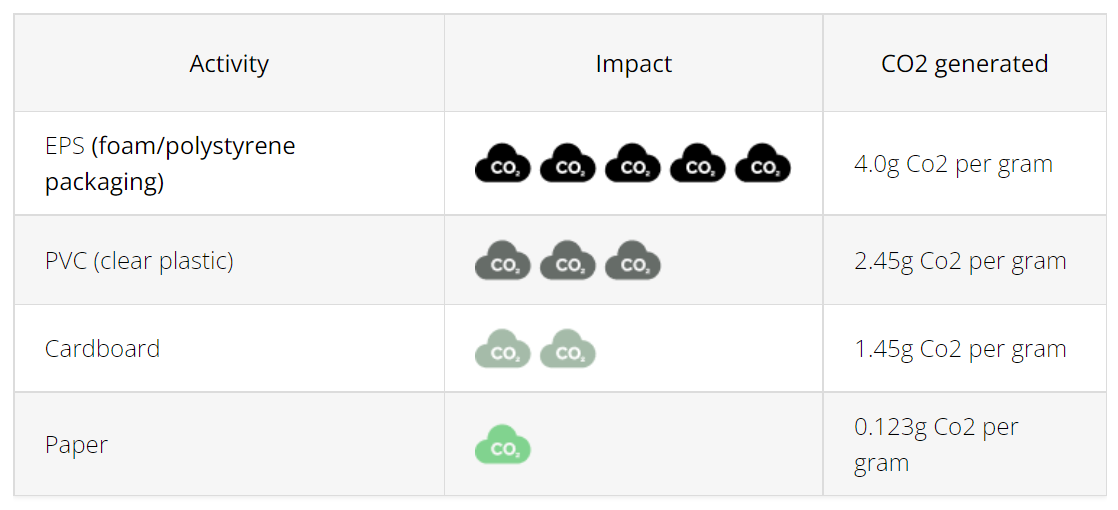
    • PACKAGING: e-commerce uses up to 10x more packaging than brick-and-mortar stores, and producing and subsequently dumping non-recyclable packaging like bubblewrap and certain plastics can inflate our carbon footprint.

    Solutions: Minimise packaging, and wherever not possible, use recycled/recyclable paper, cardboard or compostable packaging.

    Fresh Cuts Clothing uses entirely compostable packaging made from corn starch.

    Source: CarbonClick

    • DELIVERY: Shipping orders to customers in remote locations, known as the “last mile delivery”, may be carbon intensive.

    Solutions: According to a 2017 Bain Report, local emissions can fall by almost a third if consumers bundle their purchases together, and order “one box” rather than four separate ones. As ecommerce providers, we should incentivise ordering more, but less often, or giving customers the option to save money or earn points for waiting a bit longer to receive all items in one delivery, rather than immediately shipping each item when ready.

    If our products are already available in stores, we could offer to allow customers to check the stock in stores near them and reserve a product already there, rather than ordering and shipping a new one.

    Experts have also identified product returns as an issue here- 15 million tonnes of CO2e and 2 million tonnes of landfill waste are created every year from US returns alone. Providing high quality products and extensive information about them is a way to reduce return rates – something many of our members are already adept at.

    Manno.Aero, aims to reduce carbon emissions from deliveries by replacing trucks and vans with drones.

    Pointy encourages local shopping by pointing customers to local businesses where there desired products are already available – giving small local retailers an opportunity to compete with retail giants like Amazon.

    • BUSINESS RELATED EMISSIONS: The electricity, heating, gas and light needed to run our business may lead to hefty bills. Business trips and construction add to this.

    Solutions: Switching to renewable energy is a solid option which adds to anyone’s sutainabiltiy credentials. If it seems viable, installing solar panels may turn profitable in the long-term. Carbon offsetting programs, which allow buisnesses to plant trees or do similar positive things for the environment in exchange for every kilo of carbon they generate, are another avenue worth exploring.

    More broadly, we can try to implement more circular business models – facilitating customers renting, swapping, or reselling our products through our website slashes our carbon footprint. Where possible, we can offer to buy back parts or whole used products for refurbishment or reuse somewhere else in the business.

    Responsible, a Belfast-based e-commerce business that helps brands and their customers resell clothes, raised almost £5m in new investment in last year.

    Beauty market leader Tanorganic prevents 1lb of plastic from reaching the earth’s oceans for every bottle it sells – helping boost sales while reducing its impact on the environment.