We all know that gaming isn’t just for kids anymore – but how could gamification help empower patients’ recovery?
Games account for 43% of all smartphone use, and the number of active mobile gamers worldwide is over 2.2 billion. (TechJury) The prospect of levelling up, unlocking rewards and competing with others are just some of the techniques mobile game apps have used to keep players coming back…
When applied to patient care, these techniques could be a literal game changer.
Let’s take a look at 3 tech start-ups using gamification to improve patient’s everyday lives –
GAMIFYING PREVENTION
Sidekick Health (with offices in Germany, Iceland & Sweden) gamifies and rewards positive lifestyle changes, with the goal of preventing or easing lifestyle-related illnesses. The social health “game” platform leverages AI to develop personalised action plans, and empowers users to manage their medication, sleep, nutrition and exercise. Relevant content and tips are served up to keep users coming back. Sidekick Health raised €17 million in Series A funding in 2020.
GAMIFYING RECOVERY
Switzerland-based MindMaze‘s Mindmotion develops medical grade VR games to help neurological patients relearn lost skills, while stimulating neural recovery. Motion analytics, AI, VR, and cloud technologies combine to create games which promote the same movements a patient would typically practice with a physiotherapist. Patients are empowered to customise the system to their own needs, and practice in the comfort of home. In October 2021, MindMaze secured €125 million to expand its digital neurotherapeutics platforms.
GAMIFYING MONITORING
French startup Tilak Healthcare‘s mobile medical games help healthcare professionals monitor and support patients with chronic eye diseases, from the comfort of their homes. Addictive games keep players motivated by rewarding them points for taking vision tests, which then unlock addictive new worlds and puzzles. Gameplay generates data which can identify worsening or new symptoms – and the app even alerts patients when it believes a doctor’s visit is necessary. The start-up has raised a total of €12m in funding since its launch in 2016, and successfully launched a joint promotion with Novartis France in 2019.
Bonus: In an a win for accessible design, the app’s fonts and instruction speed have been adjusted to suit patients with low vision, and the map and main layout have been designed for ease of use.
This trend is a prime example of digital improving everyday lives. Not only does gamification make the patient an active participant in their own recovery, it rewards positive behaviours which stave off other problems down the road.
We commend the start-ups driving this trend forward!
How else can digital make patient’s recovery that little bit easier?
Short blog post for Bloom Partners – published January 2021.
Data is the new gold – and healthcare is no exception.
30% of the world’s data is generated by the healthcare industry. This data may reveal crucial insights and patterns for diagnosis and treatment, but lack of collection or analysis mean it is often underleveraged.
At Bloom, we have long been believers in the power of data in transforming business models. We have seen time and time again the transformative effect collecting and applying the right data can have on strategy. We are pleased to see a host of new players are harnessing healthcare data to unlock new value – and even save lives.
Today, we take a look at 3 exciting German startups in this space:
AN ALGORITHIM FOR SCREENING SYMPTOMNS Ada Health is an end-user self-assessment tool which helps patients identify the cause of their symptoms – before heading to a specialist. Users clickthrough the normal screening questions a doctor would ask to rule out conditions. The algorithm identifies likely causes, saving time for both patients and HCPs.
REFINING DATA FOR PRECISION DIAGNOSTICS Aignostics uses AI to scan massive quantities of data and output precision diagnostics for pharmaceutical research, clinical trials and CDx development. The technology maps results on user-friendly heatmaps and image overlays.
DATA-DRIVEN DIAGNOSIS Sherlog.ai is the future of radiography – this innovative AI solution analyses medical images and compares them with extensive data from the database. This provides more accurate, timely diagnoses, especially for minor or rare abnormalities which may have flown under the radar.
The massive amount of data generated by healthcare is an often-underexploited opportunity. While no one person can analyse all the data that exists about every patient, AI can gain a broad overview and uncover otherwise undiscovered patterns or problems.
Rather than replacing healthcare workers, cataloguing this data can free up HCP’s time for what they do best – providing care.
What’s the most unexpected insight you have gained from data?
Written for Bloom Partners in February 2022. This article was picked up by Climate Hack Weekly’s newsletter.
Arman Atatürk’s recent article on what 25 leading Food Tech investors are most excited to develop in 2022 is a must-read for anyone in the food innovation space! The record-breaking funding rounds and explosion of new players on the market in 2021 has set the tone for 2022 — and here at Bloom Partners, we are immensely looking forward to what will no doubt be a capstone year for Food Tech.
Today, we dip into just 3 investment areas we are especially optimistic about, and explain the exciting potential for corporates and consumers — in not-too-technical terms.
PRECISION FERMENTATION
WHAT IS IT?
Fermentation is the process whereby microorganisms break down organic compounds (like sugars) to create useful components — the most well-known example is beer fermentation, where beermakers convert sugar into alcohol. The proteins can be harvested to create ingredients such as enzymes, flavouring agents, vitamins, natural pigments and fats.
While beer has traditionally been fermented in a liquid environment, innovation in solid state fermentation (where the process is performed on a solid substrate with low liquid content) has proven to produce foods with higher yields, and lower production costs, saving on water and energy.
Microbes have been called “the third pillar” in alternative protein, and the global market for fermented alternatives is expected to reach a value of $422.26 million by 2026!
POTENTIAL FOR CORPORATES:
1. Wider range of possibilities for meat alternatives:
Consumers are moving away from traditional meat, and precision fermentation may help corporates to accelerate this “protein transition”. PF creates ingredients with over 50% protein content by dry weight, and presents exciting new opportunities to experiment with new, healthy, animal-free proteins.
2. Less intensive:
Industrial-scale brewing is far less resource and labour intensive than traditional farming. For corporates, this means drastically reduced costs, as well as a lower carbon footprint. According to Rethinkx’s Food & Agriculture Report, PF alternatives will be up to 100 times more land efficient, 10–25 times more feedstock efficient, 20 times more time efficient, and 10 times more water efficient than traditional animal proteins.
3. Safer food, for more people:
PF removes the need for antibiotics, hormones and other negative by-products associated with animal farming. The COVID-19 pandemic has raised concerns about zoonotic diseases and the risks of factory farming — which is far less efficient than PF. The large scale of PF production makes the products more affordable for a wider consumer base — securing sustainable food for future generations.
LEADING THE WAY:
In Berlin, Formo is using microorganisms to produce “realistic”, cow-free cheese proteins — and raised €42 million in its September 2021 funding round. Formo tackles a long-established pain point for vegan consumers: cheese. The taste, meltability and stretchability of cheese have proved challenging to replicate with plant-based alternatives — but Precision Fermentation launches new possibilities for this segment.
Other players are milking this technology in new ways. After a successful pre-seed round led by CPT Capital and FoodSparks by PeakBridge in 2020, Israeli precision fermentation startup Imagindairy secured $13 million it its November 2021 seed round. The startup relies on a systems and synthetic biology platform, and a production method which can be integrated into existing dairy processing facilities — drastically shortening time to market and generating yields high enough to meet broader commercial demand.
2. SIDE STREAM VALORISATION
WHAT IS IT?
Side stream valorisation is a circular value chain practice whereby firms look at their product lifecycle, and discover innovative new ways to reuse waste (“sidestreams”) in ways which derive new value for the firm and consumers. This may mean reusing or making new food, pharmaceutical or animal feed products from the byproducts which would have otherwise gone to waste.
Alarm bells are ringing as raw materials become more scarce. SSV captures as much value as possible by reusing “waste” resources at least once more, whether it as packaging, an ingredient, or an entirely new product. While reducing demand for new materials is a positive, it’s also important to ensure that the upcycling process is less energy-intensive than creating new materials.
3. Sustainability credentials.
Reusing resources is better for the environment, and will no doubt be a value add for the growing numbers of consumers concerned about their waste’s impact on the environment. According to FMCG Gurus’ 2022 trend survey, 61% of global consumers find upcycled products appealing. Sustainability should become an integral part of the brand’s identity and inspire self-expressionist consumers to consider the new product.
LEADING THE WAY:
Dutch startup Greencovery helps food manufacturers recover valuable products from their side-streams by identifying potentially useful compounds and designing the necessary industrial process to capture new value. An example may be extracting nutrients or ingredients from food waste.
An example of SSV in practise is Brazilian startup Growpack. This startup uses corn husk (a material which is often disposed of) to produce new, fully-compostable packaging, all while using 80% less water and generating 50% less carbon emissions than traditional cardboard.
3. MOLECULAR FARMING
WHAT IS IT?
Molecular farming (also known as “pharming” or GMOs) is a form of genetic engineering whereby genes which create useful pharmaceuticals are inserted into host plants that do not already have those genes, usually by “agrobacteria” (microorganisms). The proteins are harvested from the leaves and tissues of the bloomed plant, creating proteins for use in vaccines, medications, cosmetics, and most recently, food.
PBF has exploded in popularity in recent years, and Pharming will increase the range and quality of meat-free products available for consumers. An example is University of Lleida’s “Carolight”, a transgenic maize enriched with essential nutrients, and designed to make dense, high-quality nutrition more widely available in low-income markets. A “Food-as-a-Software” model, where scientists engineer foods at a molecular level to share on databases, could present thrilling opportunities for new innovation.
2. Reduced costs:
Large scale Pharming will reduce the cost of these products for consumers. At present, certain proteins in nature are too difficult or expensive to extract from natural macro-organisms. However, with Pharming, proteins are easily accessible, scalable, and modifiable. The removal of costly bioreactors, and the possibility of vertically farming plants, further reduces the costs for corporates. Plants can be cultivated on an agricultural scale to yield 100–1000 kg of the pure protein annually.
3. Health & Safety:
Unlike bioreactors, molecular farming does not need to invest time and money in maintaining sterile conditions, as plants have natural immune systems. Other advantages include easier storage and transportation. An example: plant-derived vaccines can be stored by harvesting and freeze-drying the leaves, meaning they are more heat stable and thus more convenient to transport across long distances.
LEADING THE WAY:
German biotech startup Phytowelt works with clients to develop new plants or bacteria and create desired ingredients. This may involve crossbreeding plants, or even editing genomes. The startup has even patented a specially developed process for creating a new natural raspberry flavour ingredient: (R)-alpha-ionone.
Early in 2022, Israeli startup Remilk raised $120m to further develop its cow-free milk proteins. Remilk recreates the milk proteins by taking the genes that encode them and inserting these into a single-cell microbe. Lastly, they are dried into a powder which can be used for other dairy products.
It’s an exciting time for the Foodtech space.
Not only does Foodtech present exciting opportunities for corporates, investors and consumers, it also enables us to secure a safer, more sustainable food future. The applications for technology in nutrition are infinite, and these 3 topics are just some of the groundbreaking trends in the space. We look forward to further working with clients in this crucial market space in 2022 and shape the future of food, together.
For more insights on food technology, make sure to follow Bloom Partnerson LinkedIn.
Today, we take a look into the report to understand the main challenges we face in reducing our plastic use, and highlight some startups using digital solutions to turn the tide.
5 KEY TAKEAWAYS FROM THE WWF REPORT
THE SHEER MAGNITUDE OF PLASTIC WASTE
According to WWF, up to 23 million tons of plastic waste get into the waters every year, which is equivalent to almost two truckloads per minute. Plastic production has exploded in the last two decades — in the period 2003–2016 alone, more new plastic was produced than in all previous decades combined. Only 9% of this has been recycled, and half of all plastic produced is “disposable”, designed to be used only once before being thrown away.
2. MICROPLASTICS AND IRREVERSIBLE DAMAGE
If all plastic pollution inputs stopped today, marine microplastic levels would still more than double by 2050, with some scenarios predicting a 50-fold increase by 2100. Large plastic fragments (“macroplastics) break down into smaller microplastic fragments, which in turn become nanoplastics. Even if no new plastic is dumped in the ocean, the fragmentation process of existing waste will continue for decades.
3. MARINE LIFE ENDANGERED BY PLASTICS
The WWF study found that a total of 2,141 species have been found to encounter plastic pollution in their natural environments. 88% of marine species were negatively impacted by this plastic, such as being entangled, strangled, smothered by plastic waste. Chemicals from plastics leach into the marine ecosystem and interfere with animal hormones.
4. THE NEFARIOUS EFFECTS LEAK UP THE FOOD CHAIN — AND START TO HARM HUMANS
Sinking microplastic particles are consumed by plankton and other tiny organisms, which are consumed by larger marine animals, and then by humans. 4 out of 20 brands of canned sardines and sprats were found by researchers to contain microplastics. A 2019 WWF study found that average consumers could be ingesting approximately 5 grams of plastic every week, which is the equivalent weight of a credit card.
5. THREATENING FOOD SECURITY & ECONOMIES
The UN Environment Programme (UNEP) estimates plastic waste costs the ocean economy around US$8 billion annually. Plastic pollution hinders the productivity of some of the world’s most important marine ecosystems like coral reefs and mangroves, which provide many coastal communities with food security and flood defences among other services. A study of Javan mangrove forests found a density of 2,700 plastic items per 100m2 , with plastic covering up to 50% of the forest floor at several locations.
If current trends continue, our oceans could contain more plastic than fish by 2050.
So, how can digital accelerate positive change?
Now more than ever, there is an imperative to adopt circular models, and find new solutions which involve reusing rather than dumping waste.
Here at Bloom Partners, we hope to see increased investment and research not only in monitoring the environment, but in startups, technologies and innovators developing solutions to change the way we interact with it for the better.
Let’s take a look at 6 startups harnessing digital to make this happen:
REMOVING PLASTIC FROM THE OCEAN
Dutch organisation theOcean Cleanup operates a two-prong approach: its System 002 machines harvest plastic waste from the ocean, while its preventive machines intercept and collect plastic waste in rivers, before they reach the ocean.
REUSING RECOVERED PLASTIC
Spanish startup Sea2See design and produces 100% recycled watches and sunglasses made from marine plastic collected by fishermen working along the Atlantic coast.
Swiss startup #tide collects ocean plastic and transforms it into a granular material which can be used to create various consumer goods; from jackets, to furniture and even electronic devices.
REPLACING SINGLE USE PLASTIC
German startup Wisefood provides edible kitchenware from spoons to straws, as well as more sustainable paper and wood products. The startup raised a 7-figure Series A in 2020.
Vienna-based Waterdrop developed a microdrink model. This new drink is made by compressing fruit and plant extracts into a small cube and adding flavour and vitamins to water. For every pack of Waterdrop sold, 1 plastic bottle is collected from the environment, with up to 30 million plastic bottles saved to date.
OFFSETTING PLASTIC USE
CleanHub in Berlin has facilitated 100+ brands in reducing ocean waste as their brand grows. Firms set targets such as funding collecting plastic every time they make a sale, or offsetting their carbon footprint. CleanHub and its partners have recovered over 1,071,112 kg of plastic waste so far.
Removing microplastics from our oceans (and preventing their presence there in the first place) will grow in importance in coming years. Technology will be the key in developing solutions which remove microplastics from our oceans — and equally importantly, developing new concepts which avoid plastic waste in the first place. We are excited to follow this space as exciting new technologies to emerge — from research-stage projects on bacteria which will “eat” waste plastic, to new, circular packaging.
For more insights on improving everyday lives with digital, make sure to follow Bloom Partnerson LinkedIn.
In 2020, ecommerce sales grew by almost 30% worldwide, and with more and more people shopping online, the demand for last-mile deliveries is expected to grow by 78% by 2030.
In the past, most of us would have assumed online shopping was greener than in-person shopping: but nowadays, as the scale increases, so does the impact on our environment.
According to the World Economic Forum (WEF), “there could be 36% more e-commerce delivery vehicles driving around inner cities by the end of the decade – meaning more emissions, pollution and congestion”.
Growing numbers of consumers, particularly younger consumers, are highly concerned about the visible impact their ecommerce purchases have on the environment. The most well-known of these are waste packaging, and the emissions generated delivering the package.
As most online deliveries are “single-item deliveries”, consumers may wrack up a higher carbon footprint than if they made all their purchases on one trip into the town centre.
As well as this, there are a whole host of other factors which might add to an ecommerce provider’s carbon footprint. Identifying these is a great opportunity to take stock of our whole business and find ways we can futureproof, get ahead, and appeal to the increasingly eco-conscious online shopper.
WHAT’S ADDING TO MY CARBON FOOTPRINT?
SUPPLY CHAIN: What’s in the products I sell, and are these parts or ingredients flown in from far-away countries? How eco-friendly are the methods people use to extract or create these? Transportation by truck or freight to the nearest airport also adds to the footprint.
Solution: We are certain many of our members are already making great strides and avoiding these problems in the first place: using local suppliers and making products locally slashes these carbon footprints. This is a great achievement and can easily be communicated in the brand’s marketing.
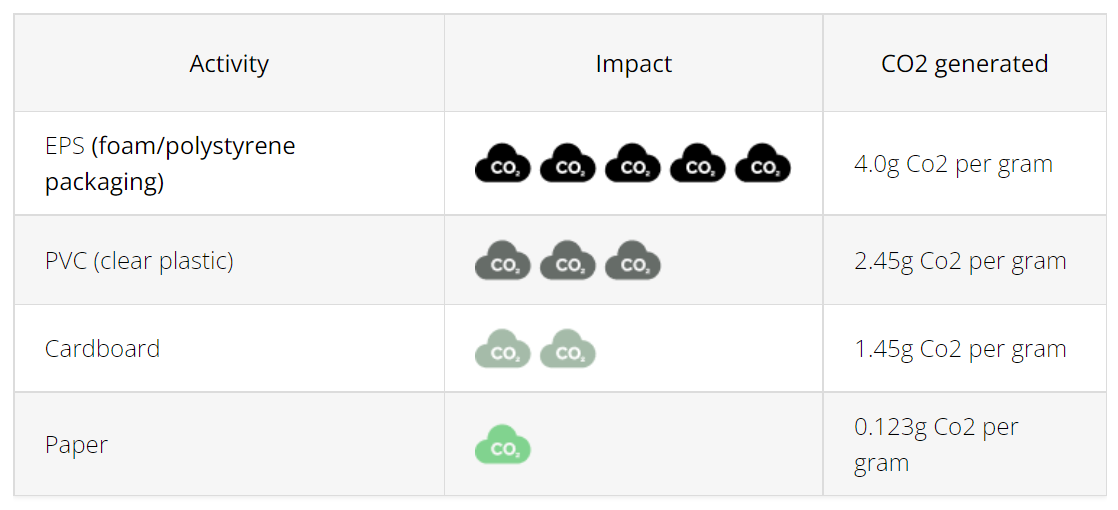
PACKAGING: e-commerce uses up to 10x more packaging than brick-and-mortar stores, and producing and subsequently dumping non-recyclable packaging like bubblewrap and certain plastics can inflate our carbon footprint.
Solutions: Minimise packaging, and wherever not possible, use recycled/recyclable paper, cardboard or compostable packaging.
Fresh Cuts Clothing uses entirely compostable packaging made from corn starch.
DELIVERY: Shipping orders to customers in remote locations, known as the “last mile delivery”, may be carbon intensive.
Solutions: According to a 2017 Bain Report, local emissions can fall by almost a third if consumers bundle their purchases together, and order “one box” rather than four separate ones. As ecommerce providers, we should incentivise ordering more, but less often, or giving customers the option to save money or earn points for waiting a bit longer to receive all items in one delivery, rather than immediately shipping each item when ready.
If our products are already available in stores, we could offer to allow customers to check the stock in stores near them and reserve a product already there, rather than ordering and shipping a new one.
Experts have also identified product returns as an issue here- 15 million tonnes of CO2e and 2 million tonnes of landfill waste are created every year from US returns alone. Providing high quality products and extensive information about them is a way to reduce return rates – something many of our members are already adept at.
Manno.Aero, aims to reduce carbon emissions from deliveries by replacing trucks and vans with drones.
Pointy encourages local shopping by pointing customers to local businesses where there desired products are already available – giving small local retailers an opportunity to compete with retail giants like Amazon.
BUSINESS RELATED EMISSIONS: The electricity, heating, gas and light needed to run our business may lead to hefty bills. Business trips and construction add to this.
Solutions: Switching to renewable energy is a solid option which adds to anyone’s sutainabiltiy credentials. If it seems viable, installing solar panels may turn profitable in the long-term. Carbon offsetting programs, which allow buisnesses to plant trees or do similar positive things for the environment in exchange for every kilo of carbon they generate, are another avenue worth exploring.
More broadly, we can try to implement more circular business models – facilitating customers renting, swapping, or reselling our products through our website slashes our carbon footprint. Where possible, we can offer to buy back parts or whole used products for refurbishment or reuse somewhere else in the business.
Responsible, a Belfast-based e-commerce business that helps brands and their customers resell clothes, raised almost £5m in new investment in last year.
Beauty market leader Tanorganic prevents 1lb of plastic from reaching the earth’s oceans for every bottle it sells – helping boost sales while reducing its impact on the environment.
MAKING AN ENTRANCE: ROCKING A NEW MARKET IN JUST ONE MONTH
Here at Bloom, we’re tremendously proud of our past projects. It’s even more amazing when we get reminded of our client’s success right in our local supermarket!
Earlier this year, the Bloom team connected with a British Kefir company on the point of launching within one of Germany’s leading supermarkets. (For those who haven’t tried it, Kefir is a fermented, cultured milk drink similar to ayran – we’ll resist the urge to make puns about entering a new culture).
THE CHALLENGE
The aim was to develop a leading go-to-market strategy, replicating the brand’s success, growth and UK-wide popularity within Germany. Entering a new market and translating the brand for international consumers is daunting for even the most seasoned brand, but the Bloom team were able to connect the best of the brand’s home learnings with our German market expertise. The end result was a successful go-to-market in just 1 month.
THE SOLUTION
MEET YOUR CUSTOMER: We adopted a customer-oriented strategy as well as our tried and tested market-entry assessment framework. We conceptualized the brand’s characteristics – how would be it be perceived by German consumers? Our consulting team spoke directly to real potential consumers to understand their motivations, behaviors, needs and pain points.
DELIVERING: We refined key insights and themes for our client. Confident our insights painted a rich picture of the real market, we applied our strategic know-how to plan the best possible strategic market entry.
THE EXTRA MILE! We had the pleasure of guiding this brand every step of the way, from branding, to packaging and promotion. We knew the product was solid, but we needed to make sure retailers and consumer-facing entities recognized this – so we prepared a pitch to help our client negotiate their place in German supermarket retail listings.
1 month later, the brand has successfully applied our go-to-market strategy – a successful project we can take pride in every time we see the product on supermarket shelves.
Bloom Partners has brought together talented strategic minds to achieve a core goal – deliver amazing results to our customers, and help you deliver something amazing to yours! Ever curious, we are always eager to discover new projects, and how we could help. Please get in touch with us or stay in touch by following our newsletter! https://lnkd.in/egPZB2vQ
Digital transformation is about bringing together the right tools, people and strategies to create meaningful change – but what questions do we need to ask ourselves along the way?
We asked Bloom’s Engagement Manager Heike Poley to share bite-size key learnings from launching new concepts.
Marketing Brew’s recent piece on Ghost Kitchens market themselves without physical locations is an exciting proposition for those of us in digital. And it’s not (only) because of the multitude of puns we can create with ghosts throughout October 😉
For anyone who has not already ordered from them, Ghost Kitchens are a new business model, dubbed “the third wave of food delivery”. Unlike restaurants, they have no dining space, and operate entirely through online delivery platforms.
While food delivery was on an upward trajectory even before Covid, lockdowns and restaurant closures have accelerated demand even further, with global digital restaurant delivery increasing 67% in 2020. Estimates even forecast that the German food delivery market will generate a staggering €393 million in annual revenue by 2024!
It’s clear that consumer behaviour has changed, and for better or worse, more and more consumers are ordering delivery instead of going out to a restaurant. Tapping into this heightened demand in an otherwise restrictive landscape (there’s a lot of extra planning involved in running a corona-safe dining experience nowadays!) is disruption at its best.
From an operations point-of-view, Ghost Kitchens are a disruptive business model which drastically reduces overhead costs.
They may be located in a competitive city centre space, but their small size makes them far more financially viable than a traditional restaurant.
Some brands may share a larger kitchen, dividing fixed costs even further.
If demand increases, the operation is easily scalable – renting a larger kitchen is far more affordable than expanding into a new restaurant space.
Other costs such as labour, dishwashing and waste are externalised thanks to riders, and consumers who dispose of the food at their own home.
Could this trend get (GHOST)busted?
Of course, there can be some pitfalls. 90 percent of millennials say authenticity is very important when choosing a brand – and new, purposefully launched ghost kitchens may not conjure the same brand loyalty as traditional restaurants. For this reason, ghost kitchen corporations sometimes lease their kitchens to well-known brands with loyal fanbases. Entrepreneur suggests the 80/20 rule is at play, with 80% of weak brands failing, and 20% achieving the brand loyalty necessary to survive in a competitive market space.
However, a plethora of strong brands suggest ghost kitchens as a concept are here to stay.
There are 3 key success factors:
📈 DATA-DRIVEN DECISION MAKING: Software solutions such as ItsaCheckmate, Deliverest and Omnivore integrate into the point-of-sale system to generate and interpret data on orders and consumer demographics. Discovering new insights such as which dishes are most popular in each neighbourhood (and with which consumers, at what time) help investors back sure-to-win new offerings. Diversifying and offering new choices for consumers may become easier than ever. A solid example of the kind of data-driven decision making we love to implement for our clients at Bloom 😊
📣 ONLINE MARKETING: MrBeast, a popular Youtuber and influencer, successfully launched a “MrBeast” Burgers virtual brand using only his social media clout as promotion. The brand is delivery only, and partners with local kitchens to meet demand. With social media, MrBeast generated such hype that the brand sold 1 million burgers in just 3 months. This is the power of digital!
🤖 AUTOMATION: Berlin startup Keatz is unlocking a new level of digital capability, using technology to cook the dishes. Cooling and heating is controlled remotely. This means uniform quality, and minimal input required from employees – so even less skilled employees can oversee a high quantity of dishes at the same time. This refines costs to the lowest possible point, guarantees quality, and frees up time for things which need a little human touch, from innovation to customer experience.
LESSONS TO NOTE
Clearly, Ghost Kitchens represent a solid opportunity for investors. What lessons can other CPG companies take from this almost overnight success story?
MAINTAIN FIRST-CLASS EXPERIENCE: Marketing Brew suggests customers still want to gain a sense of who prepared the food, and recommends communicating brand stories through packaging and user experience. The strong brand they create helps consumers overcome any doubts about quality – even when they have never seen the product. The lesson to note here: online-only services can provide just as much value to consumers as in-person ones. Go the extra mile to maintain the customer experience and all the “little extras”, so digital offerings don’t come second to analogue ones.
BUILD MEANINGFUL RELATIONSHIPS: Ghost Kitchens are dependent on aggregator platforms like food delivery apps to reach their consumer; and may be denied that direct contact which helps business relationships. If anything, this makes customer relationship building even more important. We can all take lessons from their expert use of in social media marketing to reach new customers, email marketing to retain and reactivate existing ones, and high quality user experience to build the trust which leads to long customer relationships.
EMBRACE CHANGE: We already know that lower overhead costs help Ghost Kitchens “pop up” relatively quickly. Brands should see their data insights as a feedback loop, and constantly improve to offer something better, or new, for variety-seeking consumers in an increasingly competitive landscape. Constantly revaluate feedback, trends, and changing consumer desires. Accept change as an opportunity to innovate and build something unique, rather than a source to fear!
Overall, Ghost Kitchens are a fascinating example of how digital helps old industries rock new trends. At-home dining does not spell the end for restaurants. In fact, quite the opposite is true. Ghost Kitchens completely rethink the value proposition of a restaurant – and teach us all a few lessons about the power of digital in the process.
This brochure was written as part of my summer internship with Retrac, a pre-seed Proptech startup, in 2021.
What is Retrac?
With investment in coliving spaces increasing by 210% annually since 2015, we know growth is in your near future. Welcoming more guests than ever before means exciting growth and expansion – but also a lot of new operational headaches!
Retrac is a productivity software to help you reach new levels of operational efficiency – now, and in the future. Our goal is clear: save you time and money that can be redirected to your true mission: providing an amazing guest experience.
How will Retrac help my operations?
Our all-in-one, user-friendly software helps you reach maximum operational efficiency.
In the cloud: Fully digital solution. Manage assets across various buildings, properties or even cities, from anywhere in the world.
Smoother communication: Log all incidents and notes in the app so it can be accessed by the relevant people at any time – no need to stay onsite, and no miscommunications.
Protect your investments: We monitor all assets and provide live quality updates to help avoid emergency repairs. Minimise losses and avoid expensive replacements.
Never miss an insurance claim: Retrac stores all supplier information, saving more time on insurance or warranty claims.
Smarter decisions: Our data-driven insights track asset costs and quality, helping you identify issues like high-cost bad investments, and change your plan for the future.
How it works
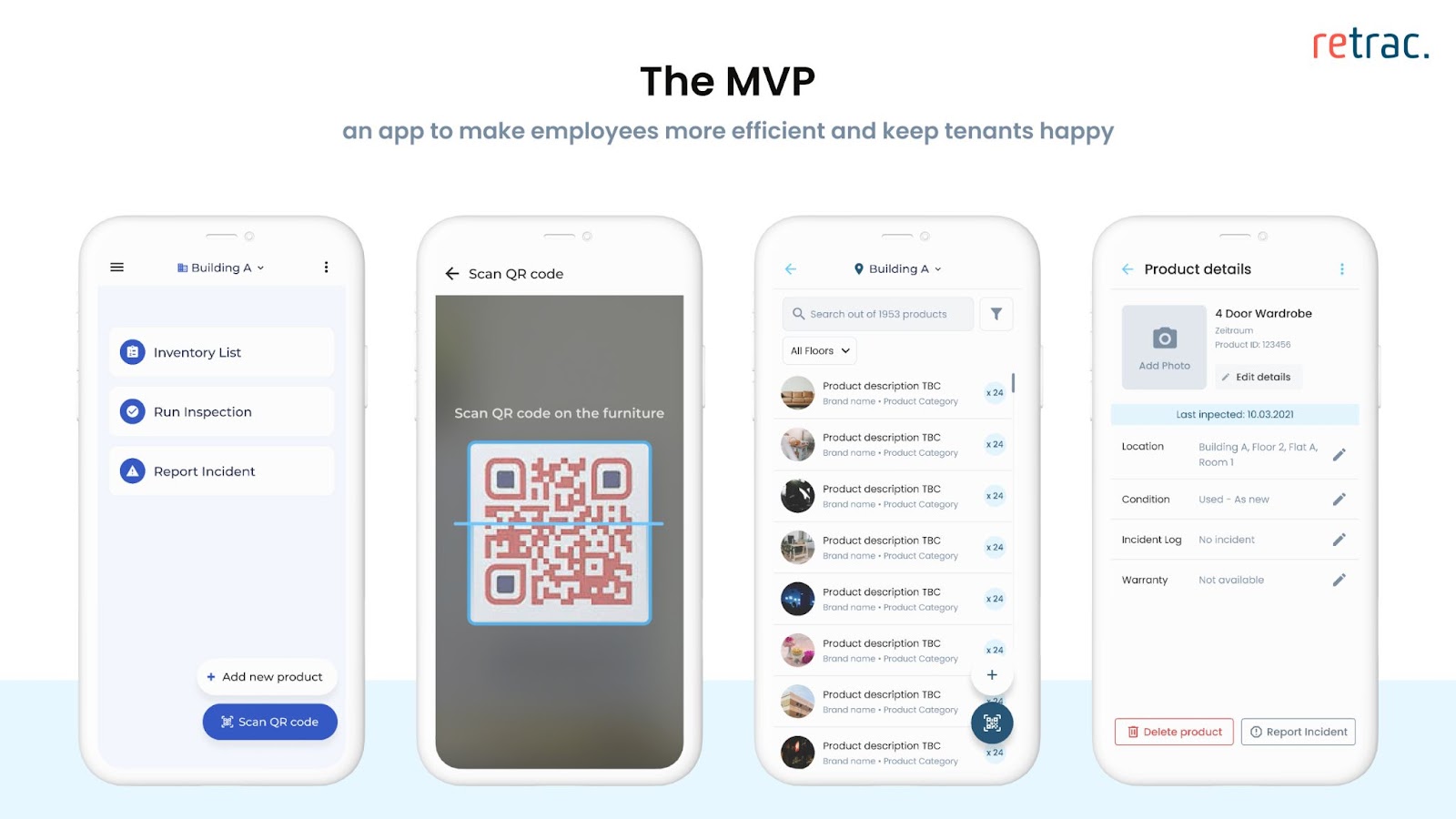
Retrac is available on both desktop and smartphone (IOS and Android), in English and German. Different employees are granted different levels of access depending on their needs.
Desktop Application > In Office: See total assets, incidents, and the most high priority tickets all in one glance. Gain insights and manage more efficiently than ever.
Mobile App > On Site: Employees download the app and can use it on-the-go.
Inventory list: quickly find information or gain an overview of assets.
Run an inspection: check rooms or apartments – super convenient after a checkout!
Report incident: simply scan the QR code to log any breakages or repair needs.
How could I use Retrac in practice?
Our research has helped us understand some of the common, frustrating situations coliving providers face. Here are some solid examples of the ways Retrac will optimise your operations:
Example A = Easy Inspections
Coliving tenants stay for just a few months, so inspections and quick turnover is important. Searching for assets and documenting issues takes time away handling new checkins.
Solution: Simply run an inspection in the Retrac app to see all items which should be in each apartment, and click an asset for more information.
Example B = Managing repairs
If an appliance suddenly breaks, finding insurance or warranty documents can take some time, and an expensive replacement or repair is needed.You may need to stay onsite to meet maintenance.
Solution: Retrac’s live quality updates let you know about likely repair needs ahead of time. Simply scan the QR code to log any incidents. No need to stay onsite – maintenance can access all notes by scanning the same QR code.
Example C = Accounting
Accounting for asset costs and losses is a very time-consuming process. It can be difficult to identify which suppliers or brands are causing issues, so companies reinvest in bad quality.
Solution: Retrac’s insights track inventory costs and highlights those with high total lifetime cost – helping you identify these poor investments, and change your plan for the future.
Contact Our Team
Retrac is growing steadily, thanks to our dedicated team. Our diverse experience ranges from multinationals like Broadcom and Facebook, to well-known real estate industry players Medici Living.
We hope this brochure has given you some insight into Retrac! Questions? Comments? Just want to discuss your needs and how we could help? We at Retrac are always happy to hear from you.