Category: Sustainability

  • 3 Foodtech Investment Trends Changing the Future of Food

    Written for Bloom Partners in February 2022. This article was picked up by Climate Hack Weekly’s newsletter.

    Arman Atatürk’s recent article on what 25 leading Food Tech investors are most excited to develop in 2022 is a must-read for anyone in the food innovation space! The record-breaking funding rounds and explosion of new players on the market in 2021 has set the tone for 2022 — and here at Bloom Partners, we are immensely looking forward to what will no doubt be a capstone year for Food Tech.

    Today, we dip into just 3 investment areas we are especially optimistic about, and explain the exciting potential for corporates and consumers — in not-too-technical terms.

    PRECISION FERMENTATION

    WHAT IS IT?

    Fermentation is the process whereby microorganisms break down organic compounds (like sugars) to create useful components — the most well-known example is beer fermentation, where beermakers convert sugar into alcohol. The proteins can be harvested to create ingredients such as enzymes, flavouring agents, vitamins, natural pigments and fats.

    While beer has traditionally been fermented in a liquid environment, innovation in solid state fermentation (where the process is performed on a solid substrate with low liquid content) has proven to produce foods with higher yields, and lower production costs, saving on water and energy.

    Microbes have been called “the third pillar” in alternative protein, and the global market for fermented alternatives is expected to reach a value of $422.26 million by 2026!

    POTENTIAL FOR CORPORATES:

    1. Wider range of possibilities for meat alternatives:

    Consumers are moving away from traditional meat, and precision fermentation may help corporates to accelerate this “protein transition”. PF creates ingredients with over 50% protein content by dry weight, and presents exciting new opportunities to experiment with new, healthy, animal-free proteins.

    2. Less intensive:

    Industrial-scale brewing is far less resource and labour intensive than traditional farming. For corporates, this means drastically reduced costs, as well as a lower carbon footprint. According to Rethinkx’s Food & Agriculture Report, PF alternatives will be up to 100 times more land efficient, 10–25 times more feedstock efficient, 20 times more time efficient, and 10 times more water efficient than traditional animal proteins.

    3. Safer food, for more people:

    PF removes the need for antibiotics, hormones and other negative by-products associated with animal farming. The COVID-19 pandemic has raised concerns about zoonotic diseases and the risks of factory farming — which is far less efficient than PF. The large scale of PF production makes the products more affordable for a wider consumer base — securing sustainable food for future generations.

    LEADING THE WAY:

    In Berlin, Formo is using microorganisms to produce “realistic”, cow-free cheese proteins — and raised €42 million in its September 2021 funding round. Formo tackles a long-established pain point for vegan consumers: cheese. The taste, meltability and stretchability of cheese have proved challenging to replicate with plant-based alternatives — but Precision Fermentation launches new possibilities for this segment.

    Source: Formo

    Other players are milking this technology in new ways. After a successful pre-seed round led by CPT Capital and FoodSparks by PeakBridge in 2020, Israeli precision fermentation startup Imagindairy secured $13 million it its November 2021 seed round. The startup relies on a systems and synthetic biology platform, and a production method which can be integrated into existing dairy processing facilities — drastically shortening time to market and generating yields high enough to meet broader commercial demand.

    2. SIDE STREAM VALORISATION

    WHAT IS IT?

    Side stream valorisation is a circular value chain practice whereby firms look at their product lifecycle, and discover innovative new ways to reuse waste (“sidestreams”) in ways which derive new value for the firm and consumers. This may mean reusing or making new food, pharmaceutical or animal feed products from the byproducts which would have otherwise gone to waste.

    POTENTIAL FOR CORPORATES:

    1. Replace waste with new value.

    Disposing of organic waste on a large scale becomes expensive — but SSV repurposes the waste, cutting out disposal costs and instead adding a new revenue stream. A highly successful example of this is Nescafe’s Nativ Cascara, a carbonated soft drinks made from the “coffee berry” fruit which surrounds the coffee bean, and would have otherwise been thrown away.

    2. Reduce demand for non-renewable raw materials.

    Alarm bells are ringing as raw materials become more scarce. SSV captures as much value as possible by reusing “waste” resources at least once more, whether it as packaging, an ingredient, or an entirely new product. While reducing demand for new materials is a positive, it’s also important to ensure that the upcycling process is less energy-intensive than creating new materials.

    3. Sustainability credentials.

    Reusing resources is better for the environment, and will no doubt be a value add for the growing numbers of consumers concerned about their waste’s impact on the environment. According to FMCG Gurus’ 2022 trend survey, 61% of global consumers find upcycled products appealing. Sustainability should become an integral part of the brand’s identity and inspire self-expressionist consumers to consider the new product.

    LEADING THE WAY:

    Dutch startup Greencovery helps food manufacturers recover valuable products from their side-streams by identifying potentially useful compounds and designing the necessary industrial process to capture new value. An example may be extracting nutrients or ingredients from food waste.

    Source: Greencovery

    An example of SSV in practise is Brazilian startup Growpack. This startup uses corn husk (a material which is often disposed of) to produce new, fully-compostable packaging, all while using 80% less water and generating 50% less carbon emissions than traditional cardboard.

    3. MOLECULAR FARMING

    WHAT IS IT?

    Molecular farming (also known as “pharming” or GMOs) is a form of genetic engineering whereby genes which create useful pharmaceuticals are inserted into host plants that do not already have those genes, usually by “agrobacteria” (microorganisms). The proteins are harvested from the leaves and tissues of the bloomed plant, creating proteins for use in vaccines, medications, cosmetics, and most recently, food.

    In 2000, the cost of creating a kilogram of a molecule was a staggering €903k — but scientific developments have reduced this to less than €100 today. Industry hopefuls aspire to make molecular farming cost competitive with animal protein in the 2030s.

    POTENTIAL FOR CORPORATES:

    1. New business models & products:

    PBF has exploded in popularity in recent years, and Pharming will increase the range and quality of meat-free products available for consumers. An example is University of Lleida’s “Carolight”, a transgenic maize enriched with essential nutrients, and designed to make dense, high-quality nutrition more widely available in low-income markets. A “Food-as-a-Software” model, where scientists engineer foods at a molecular level to share on databases, could present thrilling opportunities for new innovation.

    2. Reduced costs:

    Large scale Pharming will reduce the cost of these products for consumers. At present, certain proteins in nature are too difficult or expensive to extract from natural macro-organisms. However, with Pharming, proteins are easily accessible, scalable, and modifiable. The removal of costly bioreactors, and the possibility of vertically farming plants, further reduces the costs for corporates. Plants can be cultivated on an agricultural scale to yield 100–1000 kg of the pure protein annually.

    3. Health & Safety:

    Unlike bioreactors, molecular farming does not need to invest time and money in maintaining sterile conditions, as plants have natural immune systems. Other advantages include easier storage and transportation. An example: plant-derived vaccines can be stored by harvesting and freeze-drying the leaves, meaning they are more heat stable and thus more convenient to transport across long distances.

    LEADING THE WAY:

    German biotech startup Phytowelt works with clients to develop new plants or bacteria and create desired ingredients. This may involve crossbreeding plants, or even editing genomes. The startup has even patented a specially developed process for creating a new natural raspberry flavour ingredient: (R)-alpha-ionone.

    Source: Phytowelt

    Early in 2022, Israeli startup Remilk raised $120m to further develop its cow-free milk proteins. Remilk recreates the milk proteins by taking the genes that encode them and inserting these into a single-cell microbe. Lastly, they are dried into a powder which can be used for other dairy products.

    It’s an exciting time for the Foodtech space.

    Not only does Foodtech present exciting opportunities for corporates, investors and consumers, it also enables us to secure a safer, more sustainable food future. The applications for technology in nutrition are infinite, and these 3 topics are just some of the groundbreaking trends in the space. We look forward to further working with clients in this crucial market space in 2022 and shape the future of food, together.

    For more insights on food technology, make sure to follow Bloom Partners on LinkedIn.

  • How Will Digital Accelerate Sustainable Transformation?

    Carousel post showcasing key thoughts from consultants at Bloom Partners (published February) 2022:

  • Digital Innovation Is Key in Solving The Ocean Plastic Crisis

    Published in February 2022 for Bloom Partners.

    Last week, WWF released a harrowing report on microplastics and their detrimental effect on the ocean.

    Today, we take a look into the report to understand the main challenges we face in reducing our plastic use, and highlight some startups using digital solutions to turn the tide.

    5 KEY TAKEAWAYS FROM THE WWF REPORT

    1. THE SHEER MAGNITUDE OF PLASTIC WASTE

    According to WWF, up to 23 million tons of plastic waste get into the waters every year, which is equivalent to almost two truckloads per minute. Plastic production has exploded in the last two decades — in the period 2003–2016 alone, more new plastic was produced than in all previous decades combined. Only 9% of this has been recycled, and half of all plastic produced is “disposable”, designed to be used only once before being thrown away.

    2. MICROPLASTICS AND IRREVERSIBLE DAMAGE

    If all plastic pollution inputs stopped today, marine microplastic levels would still more than double by 2050, with some scenarios predicting a 50-fold increase by 2100. Large plastic fragments (“macroplastics) break down into smaller microplastic fragments, which in turn become nanoplastics. Even if no new plastic is dumped in the ocean, the fragmentation process of existing waste will continue for decades.

    3. MARINE LIFE ENDANGERED BY PLASTICS

    The WWF study found that a total of 2,141 species have been found to encounter plastic pollution in their natural environments. 88% of marine species were negatively impacted by this plastic, such as being entangled, strangled, smothered by plastic waste. Chemicals from plastics leach into the marine ecosystem and interfere with animal hormones.

    4. THE NEFARIOUS EFFECTS LEAK UP THE FOOD CHAIN — AND START TO HARM HUMANS

    Sinking microplastic particles are consumed by plankton and other tiny organisms, which are consumed by larger marine animals, and then by humans. 4 out of 20 brands of canned sardines and sprats were found by researchers to contain microplastics. A 2019 WWF study found that average consumers could be ingesting approximately 5 grams of plastic every week, which is the equivalent weight of a credit card.

    5. THREATENING FOOD SECURITY & ECONOMIES

    The UN Environment Programme (UNEP) estimates plastic waste costs the ocean economy around US$8 billion annually. Plastic pollution hinders the productivity of some of the world’s most important marine ecosystems like coral reefs and mangroves, which provide many coastal communities with food security and flood defences among other services. A study of Javan mangrove forests found a density of 2,700 plastic items per 100m2 , with plastic covering up to 50% of the forest floor at several locations.

    If current trends continue, our oceans could contain more plastic than fish by 2050.

    So, how can digital accelerate positive change?

    Now more than ever, there is an imperative to adopt circular models, and find new solutions which involve reusing rather than dumping waste.

    Here at Bloom Partners, we hope to see increased investment and research not only in monitoring the environment, but in startups, technologies and innovators developing solutions to change the way we interact with it for the better.

    Let’s take a look at 6 startups harnessing digital to make this happen:

    REMOVING PLASTIC FROM THE OCEAN

    Dutch organisation theOcean Cleanup operates a two-prong approach: its System 002 machines harvest plastic waste from the ocean, while its preventive machines intercept and collect plastic waste in rivers, before they reach the ocean.

    REUSING RECOVERED PLASTIC

    Spanish startup Sea2See design and produces 100% recycled watches and sunglasses made from marine plastic collected by fishermen working along the Atlantic coast.

    Swiss startup #tide collects ocean plastic and transforms it into a granular material which can be used to create various consumer goods; from jackets, to furniture and even electronic devices.

    REPLACING SINGLE USE PLASTIC

    German startup Wisefood provides edible kitchenware from spoons to straws, as well as more sustainable paper and wood products. The startup raised a 7-figure Series A in 2020.

    Vienna-based Waterdrop developed a microdrink model. This new drink is made by compressing fruit and plant extracts into a small cube and adding flavour and vitamins to water. For every pack of Waterdrop sold, 1 plastic bottle is collected from the environment, with up to 30 million plastic bottles saved to date.

    OFFSETTING PLASTIC USE

    CleanHub in Berlin has facilitated 100+ brands in reducing ocean waste as their brand grows. Firms set targets such as funding collecting plastic every time they make a sale, or offsetting their carbon footprint. CleanHub and its partners have recovered over 1,071,112 kg of plastic waste so far.

    Removing microplastics from our oceans (and preventing their presence there in the first place) will grow in importance in coming years. Technology will be the key in developing solutions which remove microplastics from our oceans — and equally importantly, developing new concepts which avoid plastic waste in the first place. We are excited to follow this space as exciting new technologies to emerge — from research-stage projects on bacteria which will “eat” waste plastic, to new, circular packaging.

    For more insights on improving everyday lives with digital, make sure to follow Bloom Partners on LinkedIn.
  • eCommerce Providers & Your Carbon Footprint


    Short article for Irish eCommerce association.

    In 2020, ecommerce sales grew by almost 30% worldwide, and with more and more people shopping online, the demand for last-mile deliveries is expected to grow by 78% by 2030.

    In the past, most of us would have assumed online shopping was greener than in-person shopping: but nowadays, as the scale increases, so does the impact on our environment.

    According to the World Economic Forum (WEF), “there could be 36% more e-commerce delivery vehicles driving around inner cities by the end of the decade – meaning more emissions, pollution and congestion”.

    Growing numbers of consumers, particularly younger consumers, are highly concerned about the visible impact their ecommerce purchases have on the environment. The most well-known of these are waste packaging, and the emissions generated delivering the package. 

    As most online deliveries are “single-item deliveries”, consumers may wrack up a higher carbon footprint than if they made all their purchases on one trip into the town centre.

    As well as this, there are a whole host of other factors which might add to an ecommerce provider’s carbon footprint. Identifying these is a great opportunity to take stock of our whole business and find ways we can futureproof, get ahead, and appeal to the increasingly eco-conscious online shopper.

    WHAT’S ADDING TO MY CARBON FOOTPRINT?

    • SUPPLY CHAIN: What’s in the products I sell, and are these parts or ingredients flown in from far-away countries? How eco-friendly are the methods people use to extract or create these? Transportation by truck or freight to the nearest airport also adds to the footprint.

    Solution: We are certain many of our members are already making great strides and avoiding these problems in the first place: using local suppliers and making products locally slashes these carbon footprints. This is a great achievement and can easily be communicated in the brand’s marketing.

    • PACKAGING: e-commerce uses up to 10x more packaging than brick-and-mortar stores, and producing and subsequently dumping non-recyclable packaging like bubblewrap and certain plastics can inflate our carbon footprint.

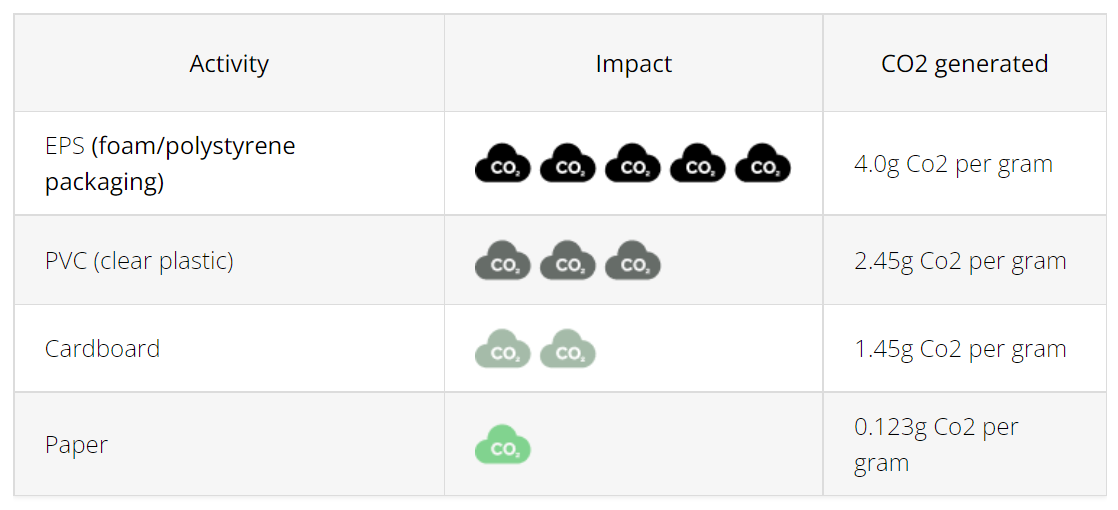
    Solutions: Minimise packaging, and wherever not possible, use recycled/recyclable paper, cardboard or compostable packaging.

    Fresh Cuts Clothing uses entirely compostable packaging made from corn starch.

    Source: CarbonClick

    • DELIVERY: Shipping orders to customers in remote locations, known as the “last mile delivery”, may be carbon intensive.

    Solutions: According to a 2017 Bain Report, local emissions can fall by almost a third if consumers bundle their purchases together, and order “one box” rather than four separate ones. As ecommerce providers, we should incentivise ordering more, but less often, or giving customers the option to save money or earn points for waiting a bit longer to receive all items in one delivery, rather than immediately shipping each item when ready.

    If our products are already available in stores, we could offer to allow customers to check the stock in stores near them and reserve a product already there, rather than ordering and shipping a new one.

    Experts have also identified product returns as an issue here- 15 million tonnes of CO2e and 2 million tonnes of landfill waste are created every year from US returns alone. Providing high quality products and extensive information about them is a way to reduce return rates – something many of our members are already adept at.

    Manno.Aero, aims to reduce carbon emissions from deliveries by replacing trucks and vans with drones.

    Pointy encourages local shopping by pointing customers to local businesses where there desired products are already available – giving small local retailers an opportunity to compete with retail giants like Amazon.

    • BUSINESS RELATED EMISSIONS: The electricity, heating, gas and light needed to run our business may lead to hefty bills. Business trips and construction add to this.

    Solutions: Switching to renewable energy is a solid option which adds to anyone’s sutainabiltiy credentials. If it seems viable, installing solar panels may turn profitable in the long-term. Carbon offsetting programs, which allow buisnesses to plant trees or do similar positive things for the environment in exchange for every kilo of carbon they generate, are another avenue worth exploring.

    More broadly, we can try to implement more circular business models – facilitating customers renting, swapping, or reselling our products through our website slashes our carbon footprint. Where possible, we can offer to buy back parts or whole used products for refurbishment or reuse somewhere else in the business.

    Responsible, a Belfast-based e-commerce business that helps brands and their customers resell clothes, raised almost £5m in new investment in last year.

    Beauty market leader Tanorganic prevents 1lb of plastic from reaching the earth’s oceans for every bottle it sells – helping boost sales while reducing its impact on the environment.

  • Why rent a tent?

    Short promotional article for Tentshare, a UK P2P platform marketplace which rents camping equipment.

    Tentshare is an online platform to help would-be campers find quality tents, equipment and tips. Do you have camping equipment lying around? Let new campers enjoy it, and earn some extra cash along the way!

    Camping is simpler and more accessible than ever – just rent the whole kit and caboodle at a time and place which suits you. Here’s why renting is the way to go:

    New adventures.

    Spur of the moment camping trip? Enjoyed your last one so much that now you want to do something completely different? Tentshare makes both possible. Rent the tent that fits your needs and return it when you are finished. Avoid carrying equipment which only takes up space in your home when not being used. We hope you discover your lvoe for camping, and if you do, you can always rent another tent or buy one later on.

    Learn from experts.

    Our community of seasoned campers are here to give you the tips you need to craft your perfect camping trip. For insider advice, check out our Instagram and Facebook pages, or spark a discussion in our forum. Our community is all about protecting the landscapes we love so much. We want to change the “single use” mindset, and believe sharing is most definitely caring – whether that’s sharing tents, tips, or new experiences! You can message tent owners directly to ask any questions, and of course, Tentshare stands by to help out in the unlikely event you have any issues with your rental.

    Be part of the sustainable revolution.

    Staycation is one of the most eco-friendly holiday options. Flights generate massive carbon emissions, while camping is just about the best way to connect with nature. Sourcing the raw materials to make tents, then producing them in factories, generates a carbon footprint. We try to keep this as low as possible by sharing tents and reducing the need to buy new ones.

    Given that you may only need to use a tent now and then, it makes more sense (for both your pocket, and for the environment) to rent one. We are excited to offer the UK’s largest range of tents for rent and are sure we have one to fit your needs. Check out out full range, and don’t forget to folow our social media for tips on making the most of your next adventure.

    Camping Grounds Munich - official Website for Munich
  • “Keeping it clean” – circular economy principles in an ecofriendly laundry company

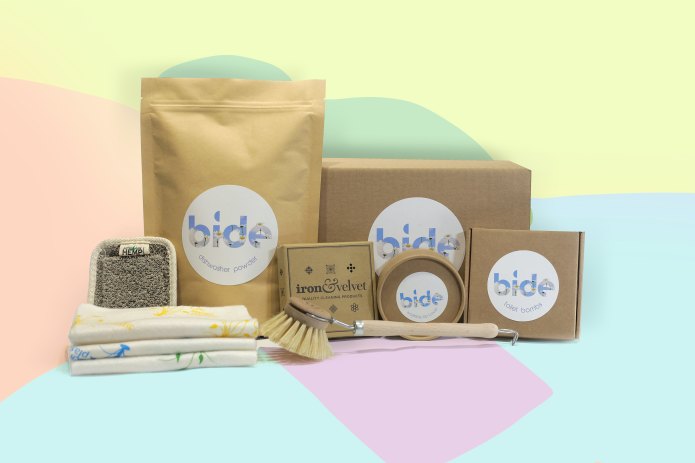
    Text written for a report for Bide Boxes. This UK company implements a new production method to create ecofriendly laundry and dishwashing products. Ingredients are sourced locally, then shipped to “homemakers” who assemble the products and distribute them locally.

    Social Enterprise: eco cleaning boxes | Indiegogo

    Our Vision

    We love clean concepts of all kinds, and keeping our planet clean is our top priority. 

    We are increasingly aware that the products we use to keep clean in fact have a disastrous effect on our environment – from the massive amount of waste generated by single-use plastic, flown around the world, before inevitably adding to the chemical pollution of our rivers.

    We also know that so much of the devastation wreaked by climate change is completely preventable, and we are determined to find more environmentally-friendly solutions that align with our values: honesty, transparency and preserving earth’s beauty for future generations.

    Here’s how we are changing things.   

    Existing cleaning products

    Virtually all UK households consume detergents for washing machines or dishwashers. Traditional products use harmful chemicals and are too intensive – harming the environment, and adding to your carbon footprint. “Universal design principles’ ‘ which guided product design in the past encouraged cleaning companies to use the strongest, harshest ingredients in every product – so that it could thoroughly clean in even the toughest situations.

    However, this level of chemicals is rarely necessary. We want to lead the change and offer an eco-friendly alternative, with all the same (if not more!) benefits.

    What are we doing as a company to reduce our carbon footprint?

    Reducing our carbon footprint is a core part of our mission. We incorporate circular economy principles and commit to reducing waste at every stage of our product’s lifecycle.

    Production: Bide relies on a “cottage industry” production chain, where locals can become “home manufacturers” and distribute the product locally – greatly reducing transport costs. We are a proud British brand, focusing on improving the communities we live in. For now, we only operate and ship within the UK. We source raw materials sustainably and minimise use of chemicals.

    Efficient transport network – Right from the start, our “home manufacturers” are key in reducing our transportation footprint. We ship products to local home-based manufacturers, always ensuring that the product is manufactured no more than 30 miles from the point of sale. No long-haul lorries, steam ships or flights – we are a local-focused business determined to support other small businesses as we grow.

    Efficient ground transportation.  On the ground, we use efficient, community-based methods like public transport as far as possible. Our “home production” system means our products are created in your local area and delivered no more than 30 miles. This minises transport costs and removes the need for polluting longhaul lorries or planes.

    Packaging – All our packaging is sourced in the UK and is fully recyclable. Even the stickers on our products are vinyl-free, improving our overall brand sustainability. 

    Use: We create new tips and hints to minimise the amount of product you need to use – saving you money, as well as helping your carbon footprint.

    Disposal: Our products are fully recyclable, with all materials going back into circulation. 

  • Camptoo: A Sustainable Staycation Idea

    A short promotional text for camptoo, a caravan rental service based in the UK.

    Target audience: medium/high earners in London. Families, road-trippers, and other staycationers.

    Otherworldly adventure is closer than ever. Scotland’s stunning North Coast 500 route is a 516-mile road trip encompassing epic landscapes, romantic castles, and even a few distilleries. Beginning at the Castle of Inverness, this route winds through farflung country roads to unveil Scotland’s world-renowned beauty, from pristine beaches to craggy mountains. If you haven’t yet experienced these wonders so close to home, now is the time to do so – all in the knowledge that your staycation choice is helping reduce those nasty carbon emissions.

    Coast Scotland Rock - Free photo on Pixabay

    With so much to see, renting a campervan is the perfect way to discover Scotland. Proud providers of the UK’s largest selection of insured campervans and motorhomes, CampToo is sure to have the perfect vehicle for you. Just select your pickup location and number of travellers to explore the full range.

    We want everyone to experience the wonder of Scotland, now, and forever. Renting a campervan is not only up to 40% cheaper than traditional rental companies, it’s also more sustainable. Here’s an example:

    Taking the train from London to Edinburgh and picking up a campervan there reduces your carbon footprint by 250kg (compared to driving your own van the long route north).  Compare this to the carbon footprint generated from an economy flight to New York – 3,260kgs – and you realise yet another benefit of this spectacular staycation. 

    Two people touring 2000km in our rented campervan generate just 500kg of carbon footprint. Compared to  7,020kg generated from a premium flight and car rental in New York.

    At the end of your trip, simply return the campervan so someone else can enjoy an epic trip of their own. Enjoy the carbon-friendly trip of your dreams, when you want, where you want, always with zero hassle.

  • Report: Coffee & Your Carbon Footprint

    The Coffee Industry

    >Industry overview

    • Key facts: > 9.5M tonnes of coffee (9.5 billion kg) is produced annually. The total trade value is US$30.9 billion (2019)
    • Coffee is the world’s most widely traded tropical agricultural commodity (ICO, 2011). 
    • Every day, the world drinks around 2 billion cups of coffee.
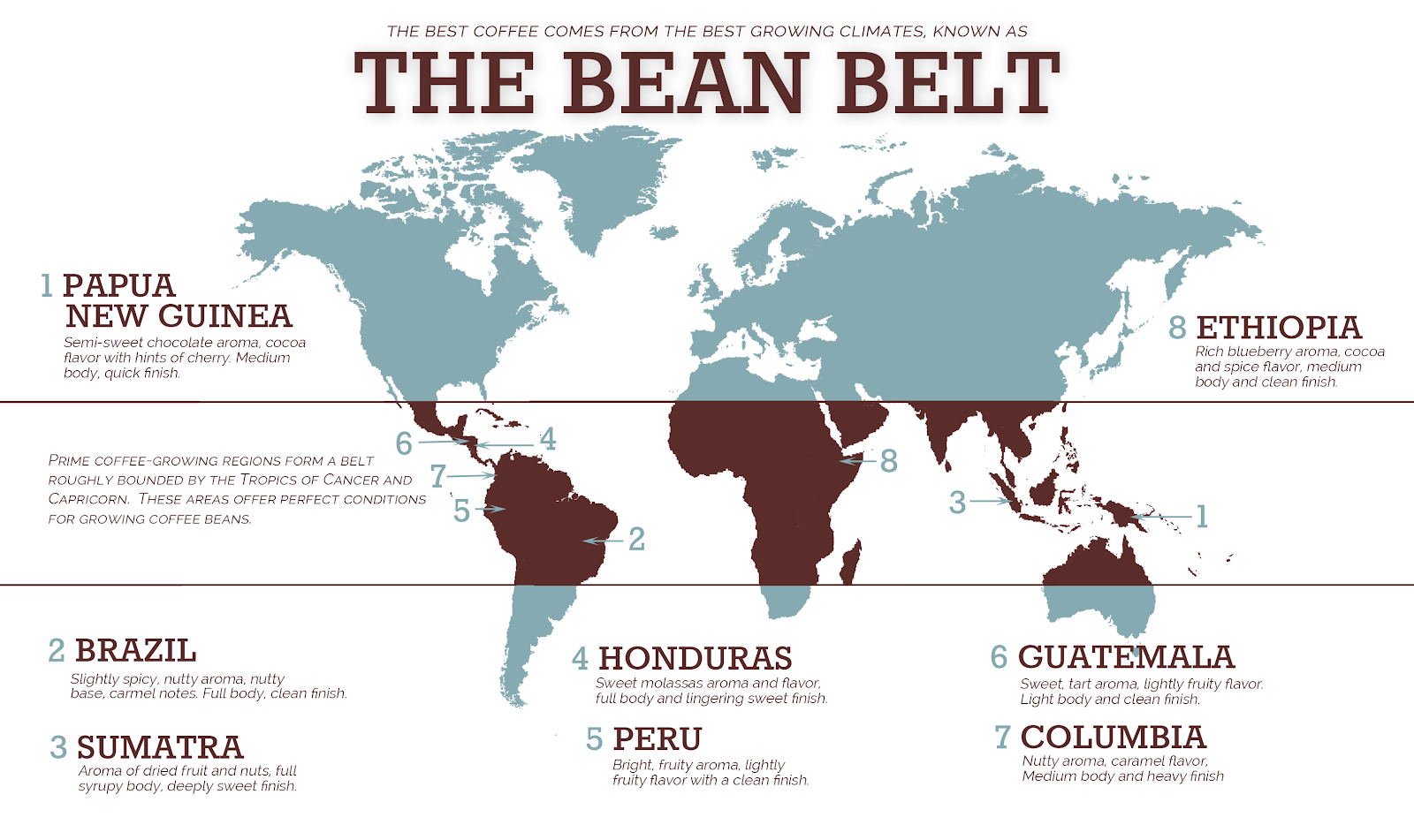
    • Raw materials: There are approx 12.5 million coffee farms in around 70 countries, termed the “bean belt”.
    • Each farm produces an average of 0.75 Tonnes of coffee. 

    source Ohio University

    • A global industry: Coffee is grown in tropical countries, but mostly consumed in North America and Europe. A global supply chain means intercontinental transport by plane or cargo ship, which adds to the carbon footprint.

    Source: Wiley

    • Industry forecast: Due to growing market demand in Asia and Oceania, coffee is expected to triple production by 2050, raising pressure on forests and other habitats. It is important to rethink our environmental impact and reduce our carbon footprint as the industry growth accelerates.
    • The main players in the global coffee industry:
    • Source: Mordor Intelligence

    > Coffee Production

    What is the coffee life cycle?

    Coffee production is a multi-stage cycle. There are multiple areas where companies could innovate and exploit opportunities to reduce their environmental impact.

    Harvesting: by hand or machinery

    Shelling: Remove fleshy outside layer, pulp is composted

    Drying: Depulped beans dried to 12% moisture (by sun or machinery)

    Dissolution: For decaf – dissolve caffeine

    Roasting: Roast beans to over 200 C (only 10 degree difference between light roast and dark roast)

    Freeze drying: Instant coffee is freeze dried

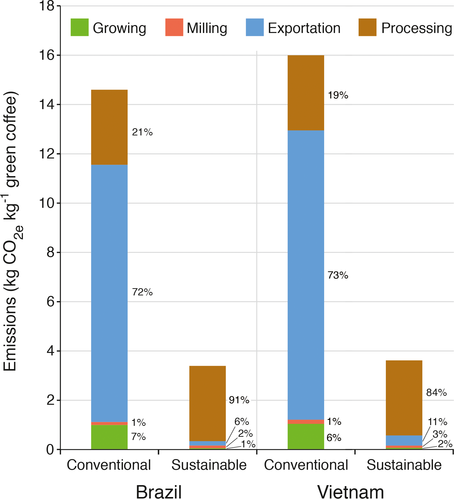
    The graph below shows the issue resources at each stage of the total coffee process (growing, milling, exporting and processing):

    source: Wiley

    Yield: 1kg of “green coffee” makes 56 espressos

    Carbon footprint: coffee industry

    -The full carbon footprint of coffee “from bean to cup” is estimated at 59.12 g CO2e per cup of coffee (PCF Pilotprojekt Deutschland, 2008). 

    – In calculating the footprint of a “cup of coffee” it is important to understand the impact of the actual coffee, heating the coffee and the additional footprint of 

    Comparing the footprint of tea and coffee: 

    The carbon footprint of a cup of tea or coffee:

    21g CO2e: black tea or coffee, boiling only the water you need

    53g CO2e: white tea or coffee, boiling only the water you need

    71g CO2e: white tea or coffee, boiling double the water you need

    235g CO2e: a large cappuccino

    340g CO2e: a large latte

    Source: Mike Berners Lee (Guardian Article)

    Breakdown of the main contributors to carbon footprint (Brazil and Vietnam)

    • Carbon dioxide: Weight for weight, coffee produced (by the least sustainable means) generates as much carbon dioxide as cheese and has a carbon footprint of almost 50% one of the worst offenders – beef
    • Growing phase:  Fossil fuel use (66% and 39%) and electricity use (16% and 51%) are the largest emission sources in the growing phase. (Brazil and Vietnam)
    • Milling phase: Fossil fuel is the largest emission source, contributing 96% and 84% of emissions in Brazil and Vietnam, respectively. 
    • Transporting: Growing 1kg of arabica coffee in Vietnam or Brazil and transporting it to the UK produces greenhouse gas emissions equivalent to 15.33 kg of carbon dioxide on average.
    • Source: Wiley

    Comparing to beef (weight for weight)

    • While coffee has half the footprint of beef weight for weight it is important to understand the impact of typical portion sizes
    • An average cup of coffee will have 8 grammes per serving whereas a typical serving of beef will be 100 grammes (Mayo Clinic) and average recommended daily US intake of 160 grammes.
    • So the portion size of a cup of coffee (8 grammes) will be 12.5% the size of a average beef serving (100 grammes) and 6.25% of the carbon footprint of a serving of beef 
    • These comparisons are for normal production of coffee. Sustainable coffee has a much lower footprint (see below)
    • Coffee is plant based compared to beef which is ruminant based

    > Conventional production vs Sustainable production

    • The total carbon footprint of conventional coffee production was 36 and 22 times higher than sustainable production in Brazil and Vietnam, respectively.

    Source: Wiley

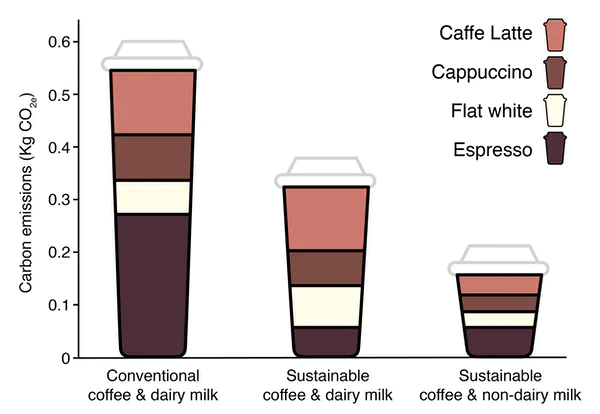
    Conventional vs sustainable growing: Just one espresso has an average carbon footprint of about 0.28 kg, but it could be as little as 0.06 kg if grown sustainably.

    This data is based on a detailed life cycle assessment of the carbon equivalent footprint of coffee produced in Brazil and Vietnam and exported to the United Kingdom. 

    Source: Wiley

    Conventional v Sustainable Carbon Footprint

    Results on the average carbon footprint of Arabica coffee from both countries:

    kg of carbon dioxide equivalent per 1 kg of green coffee (kg CO2e kg−1 ) 

    • 15.33 (±0.72) kg for conventional coffee production
    • 3.51 (±0.13) kg for sustainable coffee production. 

    There is currently no data available on the split between conventional and sustainable coffee production but we can extrapolate that the total Global footprint sits in a range between   

    What drives the difference in the Footprints?

    The 77% reduction in carbon footprint for sustainable coffee production was driven by two causes. The transportation of coffee beans via cargo ship rather than freight flight and the reduction of agrochemical inputs. The transportation factor is by far the most significant. 

    The research team also identified that further reductions could be made through optimal use of agrochemicals; reduced packaging; more efficient water heating; renewable energy use; roasting beans before exportation; and carbon offsetting. The team saw opportunities in using certification schemes to implement the other environmental impacts of coffee cultivation.

    https://www.sciencedirect.com/science/article/abs/pii/S0959652614001474

    How could the coffee industry lower its carbon footprint?

    Land use:Interestingly – coffee plants capture approximately 35% as much CO2 as the same area of woodland. (source)

    Corporate solutions: starbucks sustainable coffee challenge, 99% ethically sourced, traceable Nespresso AAA sustainable quality program, aims to reduce the carbon footprint of a cup of Nespresso coffee by 28% by 2020 in comparison to 2009 (Nespresso, 2019b). Strategies in the programme range from designing more efficient coffee machines to agroforestry and are informed by life cycle assessments (LCAs). 

    Transporting: the use of cargo ships for the transportation of coffee beans from the production countries to the United Kingdom instead of freight flights reduced estimated emissions by 10.3–11.3 kg CO2e kg–1 green coffee. Transportation via cargo ship takes 24 times longer from Brazil and 48 times longer than Vietnam. However, ships carry far more coffee beans than planes, reducing the number of journeys. This “slow travel” in the supply chain could greatly help reduce the carbon footprint. (source)

    Crop production: Using renewable energy in crop production can reduce the carbon footprint of crop production by up to 70%. (source)

    Roasting before exporting: Roasting coffee beans reduces their weight by more than half but the volume remains approximately the same. This makes a big difference to air freight which is focused mainly on weight but less important for international shipping that is mainly concerned with volume. Roasting the coffee beans before exporting them could reduce the carbon footprint where air freight is used.(source)

    Carbon footprint: Coffee drinks

    Conventional Production Sustainable Production

    Lattes 0.55kg 0.33kg

    Cappuccinos 0.41 kg 0.20kg 

    Flat whites 0.34 kg. 0.13kg

    Canned coffee: 0.76 kWh and 223 g CO2 per serve. 

    Latte:  0.54 kWh and 224 g CO2 per serve.

    Espresso coffee: 0.13 kWh and 49 g CO2 per serve.

    source: Science Direct

    Canned coffee: Despite only holding around 17% of the coffee market share, canned coffee products contribute around half of the national carbon footprint from coffee consumption. source: Science Direct 

    Milk: the question of methane emitted from cows and the carbon footprint of the dairy industry also needs to be taken into account when consumers add milk to their coffee.

    How can coffee consumers lower their carbon footprint?

    Home brewing: During the lockdown, sales of supermarket coffee and home brewing or coffee machines increased dramatically [The Guardian]. While consumers avoid the waste associated with takeaway coffee cups, coffee machines use a significant amount of energy. Since 2013, coffee machines sold in the EU must have a power management function that automatically switches the machines to a standby or off mode after the shortest possible time period of intended use (Josephy et al., 2013). 

    Water usage: “how you prepare your coffee at home can add 50% or more to its overall environmental footprint.” When you boil a full kettle of water, the energy expended is greater than the total energy expended in producing and transporting the cup of coffee to you. (The Conversation)  Numerous articles encourage consumers to only boil as much water as they need.

    Glass Jars: Highly recyclable and not particularly energy-intensive to produce. However, glass is very heavy compared with other materials. Fewer glass jars can be transported than a lighter alternative, adding to transport costs and carbon footprint. (The Conversation

    Pods: Pod-style systems in fact use less coffee and electricity per cup. However, excessive packaging waste contributes to their overall carbon footprint. They are also the bulkiest form of transport, fitting the least servings per vehicle, thus increasing transport costs and fuel use. They are heavily processed and not recyclable. (Source: Wiley)

    Recycled plastic: Arena et al. (2003) estimated a carbon footprint reduction of up to 85% where recycled plastic was used to produce packaging in comparison to virgin plastic.

    Single use/disposable coffee cups: The standard ‘to go’ coffee cup is made from paper, but coated in polyethylene – this keeps the coffee hot for longer and prevents the paper cup from collapsing. However, it makes it impossible to recycle! 6.5 million trees are cut down by the disposable coffee cup industry each year, and the production process uses as much energy as powering 54000 standard homes annually. By using one disposable cup a day, you generate 10kg of waste per year. (Source: Green Match)

    Coffee cup lids: typically made from polypropylene or polystyrene #6, a petroleum-based plastic that is difficult and unprofitable to recycle.“The sorting, cleaning, and melting of polypropylene is more expensive than creating virgin or new polypropylene lids.” Consider asking for coffee without the lid to save on plastic waste.  (Source: Green Match)

    Coffee stirrers: not ethically sourced or recyclable. Consumers are recommended to get in the habit of bringing a reusable spoon and fork with them, and using the spoon to stir if needed.

    Reusable cups: It requires resources, energy and manufacturing to create reusable cups, but these products have a much longer lifecycle and help to reduce environmental impact. A reusable coffee cup reaches a break-even energy output at around 17 uses.

    How does drinking 1 cup of coffee per day contribute to carbon emissions?

    Results from BBC Carbon Footprint calculator.

    Other Environmental issues associated with coffee

     > Climate change crisis

    Coffee requires very specific temperatures and conditions to grow. Arabica must be kept at 18-21 degrees with cool down periods (cooler nights) and adequate but not too much rainfall. The best conditions are found in Colombia, where certain elevations create prime conditions. However, the region has warmed by 1.2 degrees since 1980, causing some crops to overheat and farms to be no longer viable.

    As tropical regions are disproportionately affected by climate change, some regions will no longer be able to grow their staple crop, coffee.

    Farmers are opting to grow the “easier” Robusta crop (rather then Arabica, which requires specific temperatures). Robusta yields much lower profits, leading to poverty for farmers, and the “Global Coffee Crisis” in 2002, when coffee prices, and profits, were lower than ever in history.

    Ethiopia is expected to lose 60% of its coffee producing capability by 2060, with disastrous effects for peasant coffee farmers and coffee supply worldwide.

    > Threat of extinction

    All major coffee producing countries have been affected by the fungal disease “Coffee Leaf Rust”. The 2011-2012 Central America outbreak caused US$3.2 billion in damage and lost income. Over 60% of species are threatened with extinction, putting pressure on farmers to meet increased demand for the crop. Wild coffee species – and wild varieties of the commercial species – are almost all in decline due to competition for land use and overharvesting of the coffee plant for timber or firewood.

    “Half of the world’s coffee could be gone by 2050” – https://www.youtube.com/watch?v=BbxAt1ldZ0c&ab_channel=VICENews

    > Other Environmental Issues

    -effluent release

    -fertiliser use, affects flora, fauna, groundwater

    -intensive water use, leading to shortage and disputes between communities

    -habitat destruction

    -displacing local communities

    -human rights, worker exploitation

    carbon emissions associated with flying to usa and eu (roughly 15% of GHG emissions in coffee’s lifecycle attributed to international transportation)

  • Beef & Your Carbon Footprint

    Newsletter content created for ActBlueNow

    Target audience: teenagers and young adults in Ireland / demonstrated interest in climate change, sustainablity, environmental issues

    Beef is a huge industry, with a huge impact on your carbon footprint. 

    With 1.3 billion cattle globally, the beef industry is worth almost 332.5 billion USD src. Beef production increased from 56 million tonnes between 2016 and 2019, and is expected to grow another 3.3% by 2026.  This equates to a total carbon footprint of around 2,000,000 million tons – far greater than the total carbon footprint of Ireland, around 40 million tons.  

    Where is beef produced?: The USA is both the top producer and consumer of beef. Brazil is the #1 exporter. Consumption of beef is high in richer countries in the USA and Europe, but less so in “the Global South”. This is part of a bigger trend – often, environmentally harmful foods are grown and produced in cheaper, developing countries, and exported for sale in richer countries. 

    For this reason, consumers aren’t always aware of how beef is produced, and the environmental damage associated with the industry.

    Source  source

    Why is the beef industry growing so much? Beef has evolved from being an expensive commodity that only men ate (source) to one of the western world’s most popular foods. Why?

    • Availability: Increased demand has encouraged farmers to breed extremely large “beefy” cows which produce more meat – fuelling demand even more. Refrigerators have made it possible for people all over the world to bulk buy and freeze beef.
    • Marketing: The US Beef Industry spends 800 million dollars a year to convince consumers beef is the best option. There is emphasis on its taste, versatility, and high protein content (31g per 100g).
    • Growing world population: Gobally, the beef industry is growing thanks to increasing incomes and new markets. The world population is quickly increasing (source), and the beef industry is determined to expand and create consumer bases in new-emerging markets, such as China. 

    The world population is growing, but this doesn’t just mean new customers – it means new challenges in making sure there is enough food for us all.

    The bad news?: beef is not a sustainable industry for the future. 

    A drastic overhaul of agriculture is needed in order to feed the growing billions without destroying our planet and worsening climate change even more (source)

    By 2050, the world will need to provide 56% more calories than it did in 2010. We need to reduce our consumption and find more sustainable food – before it’s too late. 

    How does beef affect my carbon footprint?

    Beef’s carbon footprint is enormous – generating 36 kilograms of CO2eq per kilogram of beef produced! It contributes 65% of all emissions from the livestock sector.

    The emissions from beef production alone are equivalent to the total emissions generated by India – a country of over 1 billion people! (source

    How can one industry do so much environmental damage, and how does consuming it contribute to your carbon footprint?

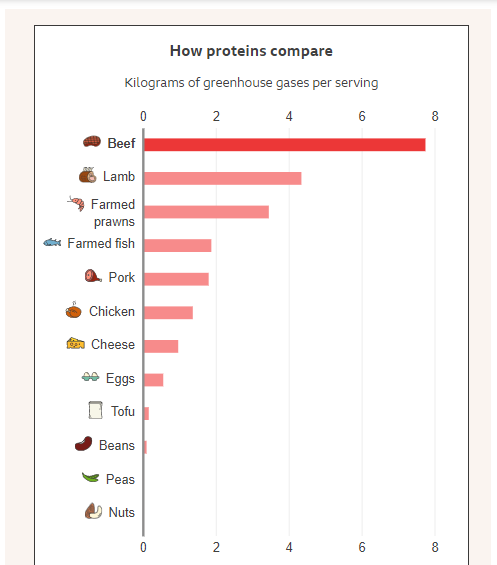
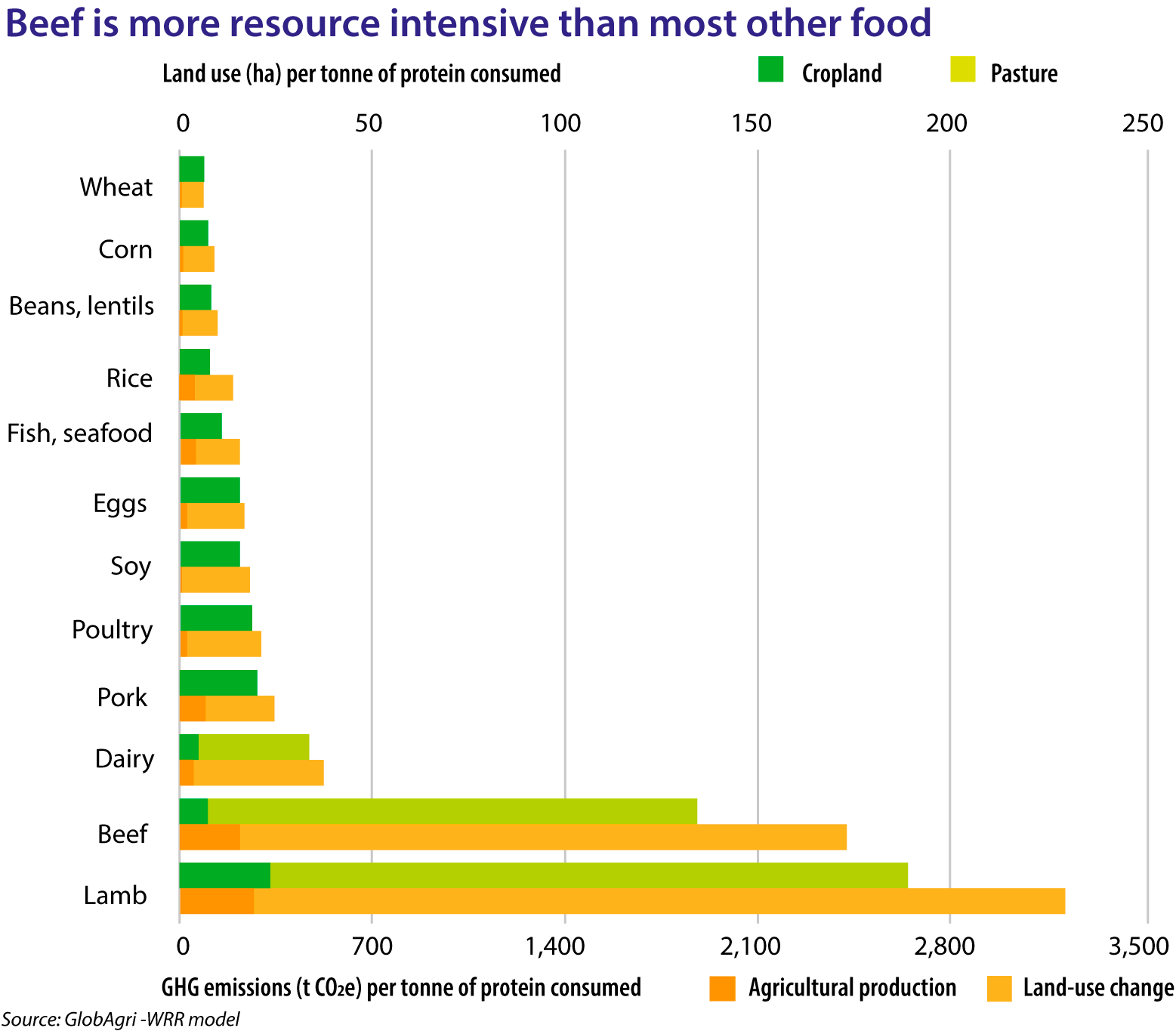
    Resource-intensiveness – Producing beef requires a crazy amount of natural resources to produce relatively small quantities.  Beef requires 20 times more land and emits 20 times more GHG emissions per gram of protein than plant proteins like beans do. 1,800 gallons of water are needed to produce one pound of beef, and this excessive water by big companies can create shortages for local people. 

    (source)

    Fertilizers and agrochemicals – The fertilizers used in growing animal feed emit nitrous oxide, and are often poisonous to land when used long term. The runoff from chemicals can poison local water and create “dead zones”, where nothing else can grow. When the land is destroyed, farmers cut down more forests to expand their growing farm. Which brings us to..

    Deforestation – As the demand for beef grows, farmers cut down forests to make more space for beef cattle. After a few years, the overfarmed land is destroyed, so farmers move on, and cut down more trees. 70% of rainforest destruction in the Amazon is attributed to beef farming. (source) When these forests are cut down, the carbon they stored is released into the atmosphere. Burning forts toxifies the air even more quickly. Native grasslands are cut down to make room for beef. Tropical deforestation for agriculture and tree plantations releases 2.6 GtCO2 yr. (source)

    (source)

    Not only do we use the carbon-storing advantages the forests provide, we replace them with something that pollutes the atmosphere – cows.

    Enteric fermentation –  Livestock create 14.5% of all greenhouse emissions (source). Cows’ are “ruminant” animals, meaning their digestive system naturally ferments their food and creates methane gas as a byproduct. This is released into the atmosphere when cows burp or pass gas. Methane is an extremely potent greenhouse gas – scientists estimate it was responsible for 23% of climate change in the 20th century! (source

    Manure mismanagement – A typical beef cow produces around 55kg of manure per day. (source) Poor management and dumping of the cow’s manure means this dangerous gas builds up and erodes the ozone layer.

    Beef is simply not sustainable. Although the industry is eager to sell even more beef (the US Beef Industry spends over 800 million USD on marketing each year!), even major meat companies like Tyson Foods and Cargill recognise beef is not sustainable, and are starting to invest in the alternative protein market.  

    It’s clear that beef’s profitability doesn’t make up for the disastrous effects it has on our planet. Companies are trying to improve manure management and create technology that prevents nitrogen in animal waste from turning into nitrous oxide – but it seems unlikely this powerful industry will make drastic changes without serious pressure from consumers of governments.

    What can I do?

    Finding out that one of your favorite foods has such a harmful effect on the earth can be worrying. The pressure to make big changes can feel daunting, but it’s important to focus on one small thing at a time.

    Reducing your beef consumption: If you aren’t ready to stop eating beef entirely, consider reducing the amount of beef you eat. 

    • The World Resources Institute recommends cutting down to 1.5 burgers per person per week. If everyone in the USA and EU did this, it would mean the world population could grow to 10 billion without needing to expand agriculture (and deforestation)  (source). 
    • Tip: For you, this could mean doing “Meatless Monday”, and cooking a large meal that you can break into portions for the rest of the week. This will free up your time (and your cash!) for the more fun things!

    (source)

    Substitute beef for fish or chicken. Switching beef to chicken could cut your dietary carbon footprint in half

    • Beef’s carbon footprint is four times the footprint of chicken and 10 to 100 times the footprint of most plant-based foods. Even small changes could make a massive difference here!
    • It is important to vary your diet, so consider eating a balance of chicken, fish (both much lower in saturated fats than beef), eggs, grains, beans or nuts – which have the lowest carbon footprint of all protein sources.

    Try a plant-based diet: Quitting meat isn’t just about animal cruelty any more, it’s about making one small sacrifice to preserve our planet for future generations. 

    • If you want to move to a vegetarian or vegan diet, ask a nutritionist or doctor about the best plan for you. Lots of nutritionists publish blogs or cookbooks with useful info.
    • Vegan or vegetarian cafes and cooking classes are great resources to learn more about good plant-based nutrition, and potentially meet some like-minded people in your area.

    Talking to your family: Let’s be realistic: especially in agricultural countries like Ireland, a lot of people instantly recoil at the thought of giving up meat. For young people living and sharing groceries with family, it can be hard to make your parents understand your decision. 

    • Always be positive. Try to share the interesting things you have learned and explain that you want your family to benefit too. Discuss why you are concerned and how you think reducing meat consumption is better for the whole planet. Don’t criticize or insult people – this isn’t how you’ll win them over, and makes them even more convinced that you’re irrational! 
    • Be patient. Understand it may take a while for them to understand. Let’s be honest, tofu and nuts haven’t had the same advertising exposure as burgers and steak, and your parents may not be as aware of carbon footprint issues as you are. 
    • Lead the change. To bring them around, why not offer to cook meals for the whole family, using chicken, fish, tofu, or whatever else you are substituting for beef? Food is the way to anyone’s heart, and a great way to show them exactly what you mean.  BBC Good Food, Pinterest, and Google are all great places to start looking for delicious vegetarian or other beef-substitute recipes. You might find your favorite beef recipes can also be done with chicken or tofu, and there is a whole world of amazing vegetarian food, from Vietnamese to Indian and beyond.

    (source)

    Make sure you get enough protein. If you chose to eat less meat, or become vegetarian or vegan, the first question you’ll be likely to hear is “how do you get enough protein?”. Understanding nutrition and making healthy choices is extremely important for everyone (think of it this way – being vegan is surely healthier than living off fast food burgers, even though those have a lot of protein!). 

    • Focus on getting the right amounts of proteins, and vitamins. Most people need around 0.8g of protein per day per kg (for example, if you weigh 65kg, you would need 52g of protein per day), but this can vary on your activity level. 
    • Remember – too much protein isn’t good either. Nutritionists recommend we eat maximum 3.5 servings of meat per week. However, a steak filet has so much protein that it’s equivalent to 3.5 servings all by itself. (source) Many people eat too much, which can lead to minor symptoms such as tiredness or headaches, but also more serious things like type 2 diabetes, cancer, cardiovascular diseases, and seizures! (source
    • Space out your proteins. Protein is most effective when absorbed gradually throughout the day. This is why it is good to “space out” your protein servings, for example, nuts and yoghurt at breakfast, chicken sandwich at lunch, and a tofu dish for dinner. Eating a steak is actually less efficient, as protein works best when absorbed slowly in the body. (source)
    • Make conscious choices. Think about where your food comes from – was it grown locally, or flown halfway around the world by a polluting jet? Is it fair trade? Are the ingredients providing all the vitamins you need, or just a sugar hit? Make healthy choices and take more interest in the ingredients in your food. Not only will you reduce your carbon footprint, you will likely feel much healthier.