MAKING AN ENTRANCE: ROCKING A NEW MARKET IN JUST ONE MONTH
Here at Bloom, we’re tremendously proud of our past projects. It’s even more amazing when we get reminded of our client’s success right in our local supermarket!
Earlier this year, the Bloom team connected with a British Kefir company on the point of launching within one of Germany’s leading supermarkets. (For those who haven’t tried it, Kefir is a fermented, cultured milk drink similar to ayran – we’ll resist the urge to make puns about entering a new culture).
THE CHALLENGE
The aim was to develop a leading go-to-market strategy, replicating the brand’s success, growth and UK-wide popularity within Germany. Entering a new market and translating the brand for international consumers is daunting for even the most seasoned brand, but the Bloom team were able to connect the best of the brand’s home learnings with our German market expertise. The end result was a successful go-to-market in just 1 month.
THE SOLUTION
MEET YOUR CUSTOMER: We adopted a customer-oriented strategy as well as our tried and tested market-entry assessment framework. We conceptualized the brand’s characteristics – how would be it be perceived by German consumers? Our consulting team spoke directly to real potential consumers to understand their motivations, behaviors, needs and pain points.
DELIVERING: We refined key insights and themes for our client. Confident our insights painted a rich picture of the real market, we applied our strategic know-how to plan the best possible strategic market entry.
THE EXTRA MILE! We had the pleasure of guiding this brand every step of the way, from branding, to packaging and promotion. We knew the product was solid, but we needed to make sure retailers and consumer-facing entities recognized this – so we prepared a pitch to help our client negotiate their place in German supermarket retail listings.
1 month later, the brand has successfully applied our go-to-market strategy – a successful project we can take pride in every time we see the product on supermarket shelves.
Bloom Partners has brought together talented strategic minds to achieve a core goal – deliver amazing results to our customers, and help you deliver something amazing to yours! Ever curious, we are always eager to discover new projects, and how we could help. Please get in touch with us or stay in touch by following our newsletter! https://lnkd.in/egPZB2vQ
Digital transformation is about bringing together the right tools, people and strategies to create meaningful change – but what questions do we need to ask ourselves along the way?
We asked Bloom’s Engagement Manager Heike Poley to share bite-size key learnings from launching new concepts.
Marketing Brew’s recent piece on Ghost Kitchens market themselves without physical locations is an exciting proposition for those of us in digital. And it’s not (only) because of the multitude of puns we can create with ghosts throughout October 😉
For anyone who has not already ordered from them, Ghost Kitchens are a new business model, dubbed “the third wave of food delivery”. Unlike restaurants, they have no dining space, and operate entirely through online delivery platforms.
While food delivery was on an upward trajectory even before Covid, lockdowns and restaurant closures have accelerated demand even further, with global digital restaurant delivery increasing 67% in 2020. Estimates even forecast that the German food delivery market will generate a staggering €393 million in annual revenue by 2024!
It’s clear that consumer behaviour has changed, and for better or worse, more and more consumers are ordering delivery instead of going out to a restaurant. Tapping into this heightened demand in an otherwise restrictive landscape (there’s a lot of extra planning involved in running a corona-safe dining experience nowadays!) is disruption at its best.
From an operations point-of-view, Ghost Kitchens are a disruptive business model which drastically reduces overhead costs.
They may be located in a competitive city centre space, but their small size makes them far more financially viable than a traditional restaurant.
Some brands may share a larger kitchen, dividing fixed costs even further.
If demand increases, the operation is easily scalable – renting a larger kitchen is far more affordable than expanding into a new restaurant space.
Other costs such as labour, dishwashing and waste are externalised thanks to riders, and consumers who dispose of the food at their own home.
Could this trend get (GHOST)busted?
Of course, there can be some pitfalls. 90 percent of millennials say authenticity is very important when choosing a brand – and new, purposefully launched ghost kitchens may not conjure the same brand loyalty as traditional restaurants. For this reason, ghost kitchen corporations sometimes lease their kitchens to well-known brands with loyal fanbases. Entrepreneur suggests the 80/20 rule is at play, with 80% of weak brands failing, and 20% achieving the brand loyalty necessary to survive in a competitive market space.
However, a plethora of strong brands suggest ghost kitchens as a concept are here to stay.
There are 3 key success factors:
📈 DATA-DRIVEN DECISION MAKING: Software solutions such as ItsaCheckmate, Deliverest and Omnivore integrate into the point-of-sale system to generate and interpret data on orders and consumer demographics. Discovering new insights such as which dishes are most popular in each neighbourhood (and with which consumers, at what time) help investors back sure-to-win new offerings. Diversifying and offering new choices for consumers may become easier than ever. A solid example of the kind of data-driven decision making we love to implement for our clients at Bloom 😊
📣 ONLINE MARKETING: MrBeast, a popular Youtuber and influencer, successfully launched a “MrBeast” Burgers virtual brand using only his social media clout as promotion. The brand is delivery only, and partners with local kitchens to meet demand. With social media, MrBeast generated such hype that the brand sold 1 million burgers in just 3 months. This is the power of digital!
🤖 AUTOMATION: Berlin startup Keatz is unlocking a new level of digital capability, using technology to cook the dishes. Cooling and heating is controlled remotely. This means uniform quality, and minimal input required from employees – so even less skilled employees can oversee a high quantity of dishes at the same time. This refines costs to the lowest possible point, guarantees quality, and frees up time for things which need a little human touch, from innovation to customer experience.
LESSONS TO NOTE
Clearly, Ghost Kitchens represent a solid opportunity for investors. What lessons can other CPG companies take from this almost overnight success story?
MAINTAIN FIRST-CLASS EXPERIENCE: Marketing Brew suggests customers still want to gain a sense of who prepared the food, and recommends communicating brand stories through packaging and user experience. The strong brand they create helps consumers overcome any doubts about quality – even when they have never seen the product. The lesson to note here: online-only services can provide just as much value to consumers as in-person ones. Go the extra mile to maintain the customer experience and all the “little extras”, so digital offerings don’t come second to analogue ones.
BUILD MEANINGFUL RELATIONSHIPS: Ghost Kitchens are dependent on aggregator platforms like food delivery apps to reach their consumer; and may be denied that direct contact which helps business relationships. If anything, this makes customer relationship building even more important. We can all take lessons from their expert use of in social media marketing to reach new customers, email marketing to retain and reactivate existing ones, and high quality user experience to build the trust which leads to long customer relationships.
EMBRACE CHANGE: We already know that lower overhead costs help Ghost Kitchens “pop up” relatively quickly. Brands should see their data insights as a feedback loop, and constantly improve to offer something better, or new, for variety-seeking consumers in an increasingly competitive landscape. Constantly revaluate feedback, trends, and changing consumer desires. Accept change as an opportunity to innovate and build something unique, rather than a source to fear!
Overall, Ghost Kitchens are a fascinating example of how digital helps old industries rock new trends. At-home dining does not spell the end for restaurants. In fact, quite the opposite is true. Ghost Kitchens completely rethink the value proposition of a restaurant – and teach us all a few lessons about the power of digital in the process.
This brochure was written as part of my summer internship with Retrac, a pre-seed Proptech startup, in 2021.
What is Retrac?
With investment in coliving spaces increasing by 210% annually since 2015, we know growth is in your near future. Welcoming more guests than ever before means exciting growth and expansion – but also a lot of new operational headaches!
Retrac is a productivity software to help you reach new levels of operational efficiency – now, and in the future. Our goal is clear: save you time and money that can be redirected to your true mission: providing an amazing guest experience.
How will Retrac help my operations?
Our all-in-one, user-friendly software helps you reach maximum operational efficiency.
In the cloud: Fully digital solution. Manage assets across various buildings, properties or even cities, from anywhere in the world.
Smoother communication: Log all incidents and notes in the app so it can be accessed by the relevant people at any time – no need to stay onsite, and no miscommunications.
Protect your investments: We monitor all assets and provide live quality updates to help avoid emergency repairs. Minimise losses and avoid expensive replacements.
Never miss an insurance claim: Retrac stores all supplier information, saving more time on insurance or warranty claims.
Smarter decisions: Our data-driven insights track asset costs and quality, helping you identify issues like high-cost bad investments, and change your plan for the future.
How it works
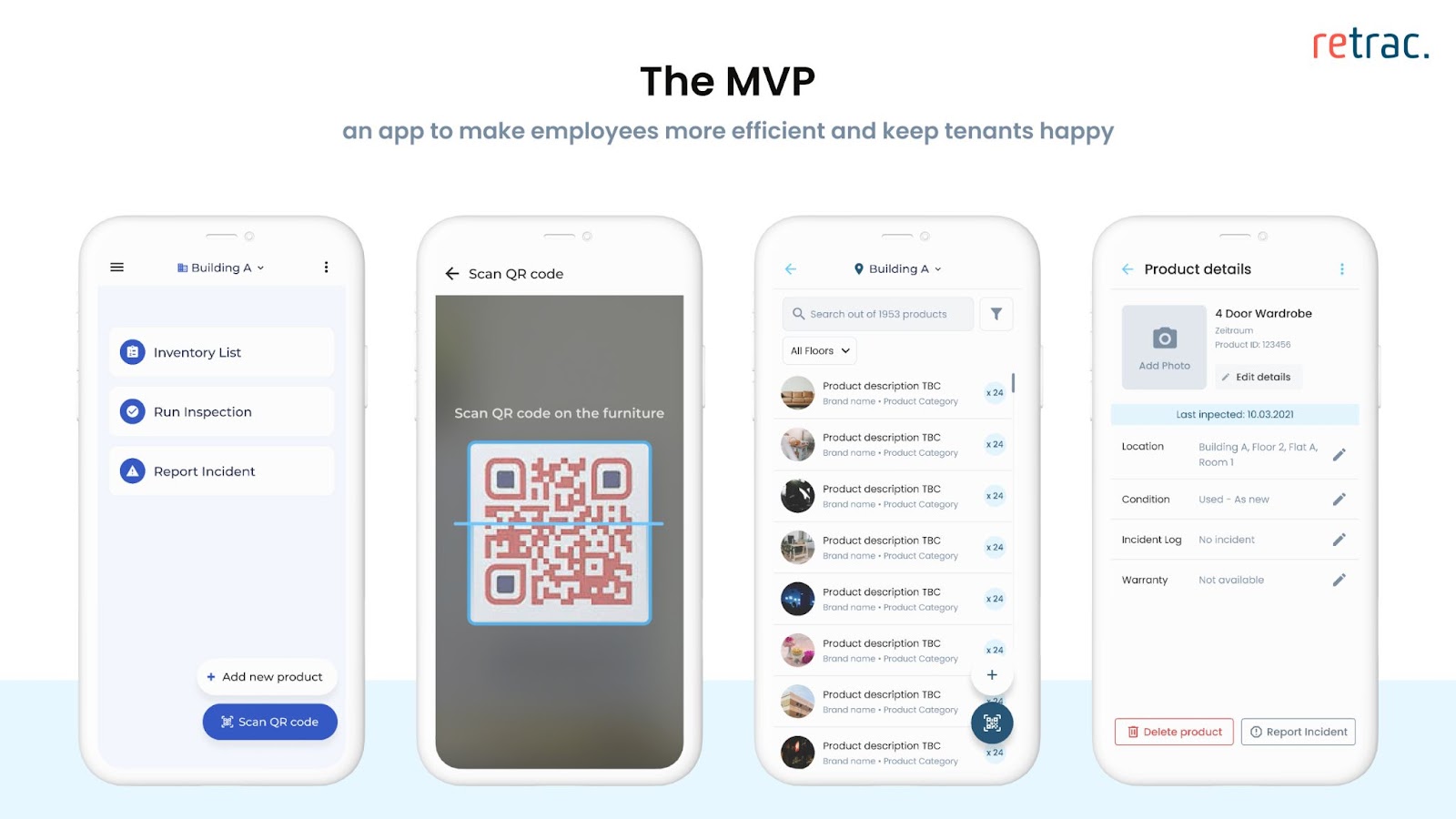
Retrac is available on both desktop and smartphone (IOS and Android), in English and German. Different employees are granted different levels of access depending on their needs.
Desktop Application > In Office: See total assets, incidents, and the most high priority tickets all in one glance. Gain insights and manage more efficiently than ever.
Mobile App > On Site: Employees download the app and can use it on-the-go.
Inventory list: quickly find information or gain an overview of assets.
Run an inspection: check rooms or apartments – super convenient after a checkout!
Report incident: simply scan the QR code to log any breakages or repair needs.
How could I use Retrac in practice?
Our research has helped us understand some of the common, frustrating situations coliving providers face. Here are some solid examples of the ways Retrac will optimise your operations:
Example A = Easy Inspections
Coliving tenants stay for just a few months, so inspections and quick turnover is important. Searching for assets and documenting issues takes time away handling new checkins.
Solution: Simply run an inspection in the Retrac app to see all items which should be in each apartment, and click an asset for more information.
Example B = Managing repairs
If an appliance suddenly breaks, finding insurance or warranty documents can take some time, and an expensive replacement or repair is needed.You may need to stay onsite to meet maintenance.
Solution: Retrac’s live quality updates let you know about likely repair needs ahead of time. Simply scan the QR code to log any incidents. No need to stay onsite – maintenance can access all notes by scanning the same QR code.
Example C = Accounting
Accounting for asset costs and losses is a very time-consuming process. It can be difficult to identify which suppliers or brands are causing issues, so companies reinvest in bad quality.
Solution: Retrac’s insights track inventory costs and highlights those with high total lifetime cost – helping you identify these poor investments, and change your plan for the future.
Contact Our Team
Retrac is growing steadily, thanks to our dedicated team. Our diverse experience ranges from multinationals like Broadcom and Facebook, to well-known real estate industry players Medici Living.
We hope this brochure has given you some insight into Retrac! Questions? Comments? Just want to discuss your needs and how we could help? We at Retrac are always happy to hear from you.
Article/information written for a client who wanted to explain the very basic conceptc of SEO to their team.
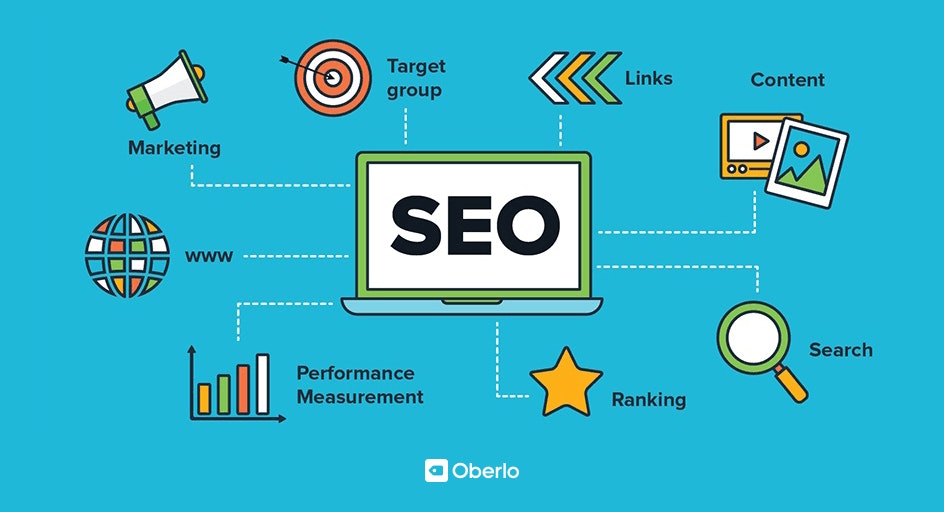
SEO (Search Engine Optimisation) is the process of making your webpages as “readable” as possible – both to people, and search engines.
Google uses “crawlers” to scan pages on the internet and rank them based on their readability. When people google a phrase, Google shows them the websites with high rankings first. This means those websites “rank higher” on the search engine results pages (SERP).
Note that Amazon and Euroflorist, companies with highly professional SEO practices, appear first. Smaller florists with less readable websites may be on the 2nd, 3rd, or even 45th page depending on ranking, and are rarely discovered by searchers.
90% of googlers do not look past the first page of search results, so appearing on the first page is a high prioirty. The goal of this is driving “organic traffic” (clicks from new visitors who found you on Google, as opposed to paid advertising). So, just how do people do this?
Understand your audience’s questions.
The primary way to rank higher on the SERP is to answer the questions people are Googling. If someone googles “where can I rent a tent”, pages which use this phrase and the keywords (“rent, tent”) will appear higher up.
Identify and target keywords.
Go to Keyword Rank Checker, and search the keywords you think relate to your website. You can find out where your webpage “ranks” compared to others, i.e, where it will appear on the SERP if someone searches this keyword. Check if a keyword is “longtail” or “short-tail”- this tells you how many competitors you have, and how easy it will be to “rank high” for it. For example, ranking high for “shoes” would be very difficult (longtail) as there are many, many websites selling shoes. However, ranking for “parking near Green Street” (short tail) receives fewer searches but has few competitors, and is easier to rank for.
User experience.
Make sure your website is well lined out, easy to navigate, and helpful. A high “bounce rate” (people who click in to your site, read for just a few seconds, find it unhelpful, and go bck to Google) will lower your rating.
Landing page.
Make sure your landing page has a fast page load speed and that all sections of your website are accessible from it.
Original content.
Avoid copy and pasting content form other websites. Google prioritises pages with unique content which directly answers the search question. Pages with plenty of relevant content (aticles, videos or other information) rank higher. Googl’e mission is to connect people with the answers they want, so Google prioritises the pages it feels can do this.
Use headings, subheadings, paragraphs, and bullet points.
Google prefers readable formats. Lists (especially of 3, 5, or 10 points) are deemed most readable by the algorithm. Ensure you use headings (h1), subheadings (h2), etc. Optimising these so the page is broken in to more readable parts is just one aspect of on-page SEO. Use bold font for primary keywords.
Short paragraphs and mixed length sentences.
Keep paragraphs short, and make sure all information is snappy and well-written. Google also prefers paragraphs with some short and some long sentences. This is considered more readable.
Images.
Include images, but make sure you always provide the copyright and description. The description cna be found in the image’s code and describes the image content for Google’s crawlers (it is also what is read allowed to blind computer users).
Backlinks.
Google prefers pages which link to many other pages on the internet. You can also include links to other pages or articles in your domain. Google prioritises this “connectedness” as it is more likely to direct searchers to the answers they requested. Page ranking also increases if you receive a lot of backlinks, especially when these backlinks come from highly-ranked pages. Fix pages which have “broken backlinks” (links which lead to the wrong page or pages which java been deleted), as you will be penalised for this.
Ambient marketing is a marketing concept which uses non traditional ad space to promote brands in a memorable, real-world way. “Ambient” refers to everything in your immediate environment – in a city, this could be anything from the pavement and walls to benches, escalators and everyday objects. Ambient marketing is often related to OOH (Out-of-Home) or outdoor advertising, but includes objects, too.
At first, ambient marketing was limited to things like blimps or projecting images on to buildings, but it wasn’t long until “everything” became ad space. Lamp posts, shopping trolleys, escalators, you name it, someone has an ad there!
Leaving a lasting impression, creating buzz, and inspiring photo ops are just some of the goals of ambient marketing!
Read ahead to see how well-known brands have used ambient marketing in cities across the world.
Ambient Marketing #101: Everything is ad space
Clearly, Ambient marketing sees everything as potential ad space, including banal items like bus stops and benches. Someone realised wooden benches look kind of like a KitKat, and the famous campaign was born.
Even tiny objects can be used for ambient marketing. Many companies use beer mats to promote their brands (we have to give whoever started this some credit – there’s no better place to promote alcoholic drinks than in a bar!), and Irish stout brand Guinness even created “Christmas postcard beer mats”, retro beer mats featuring well-known bars and feel-good messages which Irish pubgoers can mail to friends abroad, using novelty Guinness mailboxes, of course.
“Go big or go home” is sometimes the name of the game in ambient marketing. Most people feel so bombarded with ads that companies have to go the extra mile to grab their attention – and what better way to do this than with an enormous, blimp-size object planted right in their line of view? The UK National Lottery sent six giant lottery balls floating down the River Thames in London in 2013 to remind people to play the lottery.
For better or worse, giant objects are definitely one of the most memorable forms of ambient marketing!
However, some campaigns attract criticism. Some people say they ruin the historic character of cities and are just plain ugly. Unlike the installations or benches, these generally don’t serve any purpose other than marketing, and are unlikely to be recycled. An example is Bounty’s “make small work of big spills” campaign in the USA.
Unusual objects
Bags and vehicles make use of space the company already “owns”, but some ambient marketers go one step further – guerilla marketing. Guerilla marketing follows no rules and uses controversial methods and publicity stunts which some people may find over-the-top or inappropriate. It relies on the element of surprise and provokes curiosity by placing unusual objects in mundane everyday environments.
It sometimes isn’t immediately obvious what the advertisement is for, so onlookers need to read accompanying ads to figure out what they’ve just seen. Lay’s chips Canada used this ambient marketing technique to promote the fact that their ingredients are sourced not far from the city.
Different people react differently to these kind of ads – some think it’s like a vulgar, commercial form of modern art, but others think it brings imagination to otherwise boring urban landscapes. DKNY’s “Explore Your City” campaign in 2008 was widely criticized for planting “eyesore” orange bicycles on New York street corners and for tastelessly copying the existing Ghost Bike social marketing campaign.
Full-on installations are an increasingly popular option for big-budget ambient marketers, or anyone with an innovative concept to demonstrate. It’s the next generation of product demos and stalls which encourage potential customers to try out products.
IBM’s “Smart Ideas for Smarter Cities” campaign provided innovative real-world solutions such as ramps and rain shelters – which most people agree are useful, as well as memorable. IBM uses the installations to demonstrate their concept, as well as their commitment to simplicity and problem solving.
This is a great way to communicate with the exact person who could benefit from your product, as well as create positive associations and brand awareness. Other brands such as Volvo use installations as a way of framing their brand as “fun” and getting involved in the community.
Experiential marketing can tie in well with ambient marketing. Companies offer memorable interactive experiences for customers, like the IKEA Sleepover or the Smirnoff comic book party. However, ambient marketers have hidden some experiences in the everyday environment. Coco-Cola’s “Happiness Machine” invites bored people waiting at Swedish bus stops to get a taste of summer.
Promoting social change with everyday objects
Charitable organisations and public health initiatives have used ambient marketing to get people thinking about their causes. Canadian non-profit organisation Raising the Roof created a poster campaign to raise awareness of homelessness and encourage viewers to reflect on their attitudes to homeless people.
While extremely minimalist, these posters speak volumes. They seem to blend seamlessly into the environment, but leave a lasting impression on anyone who stops to read them – a perfect example of ambient marketing!
Other campaigns use everyday objects to draw people’s attention to issues such as sustainability. WWF designed an eye-catching paper towel dispenser to make people aware of waste and its effect on the rainforest.
Small is beautiful. Stickers are another classic example of ambient marketing. This is perfect for small and niche brands – stickers are very cheap to produce, and the kind of places you typically see them are free and open to all. Stickers are an uncontroversial form of ambient marketing – they add character to grey walls, lamp posts and bus stops which could use some colour! However, designing a sticker which will “stick out” on a crowded wall will be a challenge.
Stickers could also be combined with street art, graffiti and stencils to communicate an edgy, creative brand – this fits the vibe of a trendy neighbourhood much more than a billboard does!
Bagvertising
“Bagvertising”, or designing one-of-a-kind, eye-catching branded bags, is an underrated form of ambient marketing. As more and more consumers prefer to use reusable tote bags, brands are investing in unique, quality designs which will be seen again and again by other shoppers.
The design should have character and convey something about your brand or product. Bulgarian beer brand Shumensko has been using this distinctive bag since 2009, and it is still one of the most commonly-cited examples of ambient marketing on the internet.
The bag looks like a crate of beer, and might put the idea of grabbing some cold ones in passerby’s minds. An added bonus: it integrates well with the brand’s other campaigns, using the same font and colours. Being distinctive and standing out is key in a market where consumers have so many brands to choose from.
Vehicles are moving advertisements
Advertising on public transport is not a new technique, but ambient marketers take it a step further by using public transport itself as a medium. Copenhagen Zoo’s ads look like something from an action movie and are sure to stand out in an otherwise mundane urban setting. This is a profitable strategy for a local advertiser – presumably anyone who sees a Copenhagen city bus is already in Copenhagen and a potential customer for the zoo!
Similarly, some companies use their transit vehicles to promote the brand on the road. Innocent Smoothies “grassy van” is definitely eye-catching and grabs the attention of passers-by, as well as drivers. Its grassy-look communicates the brand’s commitment to natural, good old-fashioned ingredients, which integrates well with Innocent’s brand values.
Although the billboard doesn’t mention McDonald’s, it lists out the ingredients in a burger – substituting minimalist typeface for images. McDonald’s is a major global brand and can rely on “reminder marketing”. This is a frightening realisation for some – yes, even the most savvy, skeptical people have absorbed brand associations without realising it!
Another example of “invisible” branding is Coco-Cola’s ad, which doesn’t even feature a Coke bottle – your brain’s associate capacities do the work.
Of course, these are just some of the ambient marketing techniques being used all around the world. With more and more competition, companies are getting creative, and campaigns change by the season.
What are the best (or worst) ambient marketing campaigns you have seen? What do you consider the most effective form of ambient marketing? What would you do differently?
People conduct 5.6 billion searches on Google everyday. Yes – every DAY!
With 90% of the market share, Google is the most widely used search engine in most countries, and the first place most people look for products and services.
Whether you’re looking to grow locally or globally, making sure your brand is visible on Google is the fastest way to grow your customer base.
The good news: Google Ads’ intuitive interface has made promoting your brand online easier than ever.
Machine learning and algorithms do a lot of the heavy lifting. To get started, all you have to do is choose your goal (more clicks? Leads? Sales?), what kind(s) of ad campaign to run, and how much you want to spend. If you’re new to online advertising, this may seem a little overwhelming – so let’s start with the basics.
Where can I advertise on Google?
There are 5 main types of Ads on Google:
Search – These are ads that appear when people search for something on Google. Google’s crawlers (a programme that “crawls” the internet looking for websites to add to Google’s directory – contrary to popular belief, Google doesn’t actually own the internet, so you aren’t automatically listed!) usually find and “rank” websites based on how relevant they are to the “keyword” searched. The best quality websites appear closer to the top of the Search English Results Page (SERP).
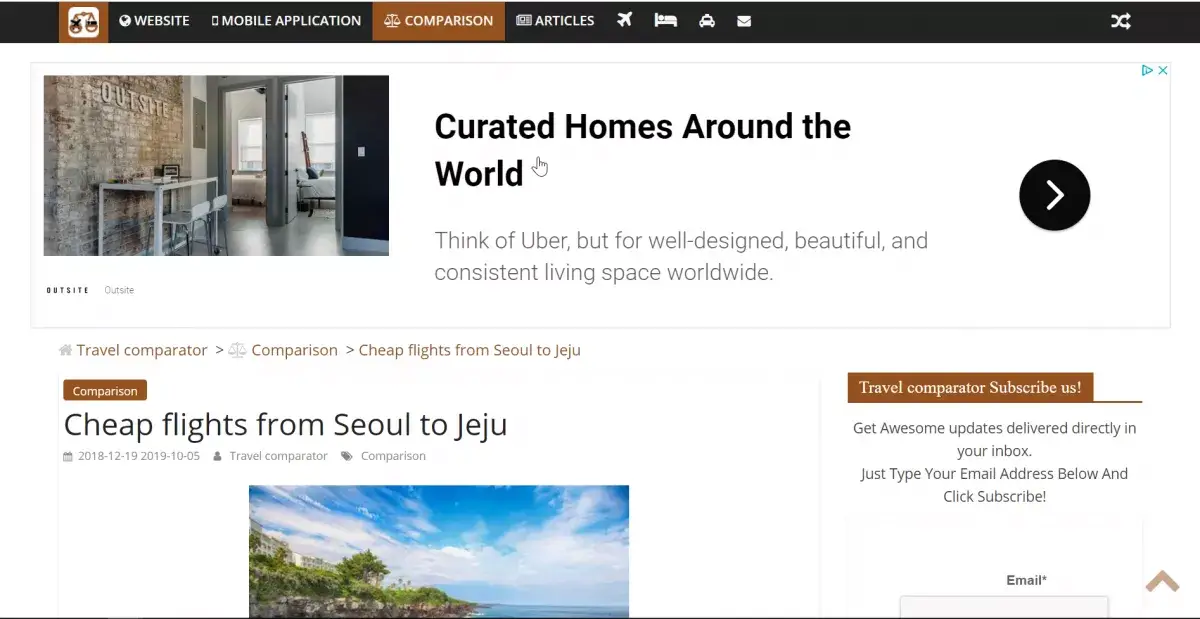
As you can see, Ads appear at the top of the page, and have the added advantage of not “looking” too much like an ad. They consist of a link, title and description, like any other search engine result.
Display – Have you ever been reading the news online when suddenly you see an ad for a product you hovered over.. A week ago? This was a Google Display Ad.
Over 2 million websites, including many online stores, blogging platforms and news sites, are part of the Google “Display Network”. This means they offer their “ad space” to Google, which then uses machine learning and algorithms to personalise the ads for each user. The Google Display network is estimated to reach over 90% of internet users, so this is a great way to reach new audiences, as well as remind old customers that you’re still there.
The ads you see are related to your Google search history and interests. Ads can be adjusted to only appear to local or regional users, to a certain age group, to parents (for children’s products), or to those who work in certain industries.
If designing ads isn’t your thing, display ads could still be a great option for you. Just upload your “assets” (images, headlines, logos, videos, descriptions, etc) and Google will create a “responsive display ad”, an automatically-generated ad. Google Ads uses machine learning to test out different combinations and “optimise” your ad – i.e, figure out which look gets you the most clicks.
Shopping Ads
Formerly known as “Google Product Search”, Google Shopping enables shoppers to search for a particular item, and then compare prices and offerings from a range of stores. Basically, it’s a Google search engine for stores. This makes shopping easier for customers, and it’s also a great way to reach new audiences, promote your brand, and drive traffic to your website. The ads appear whenever someone searches for the product on Google, as well as in Google Images or on Partner Sites.
Users can also click the “Shopping” tab to browse all Google Shopping Ads.
Google knows your location and prioritises ads from companies in the searcher’s region, or with products which match your interests.
Google Ads is simple to use, and Shopping ads are no exception – just upload your product data (photo, title, price, store name, etc) and create a campaign. You can group your products and list their attributes to make sure the right customer finds them. You can also access data on how many clicks your ads receive, or how many “impressions” (potential customers viewing your product for 10 seconds or more).
Video
You know the ads that play before the video on Youtube? Or those random videos that pop up on the side of other sites? These are Google Video Ads, and they appear on Youtube (owned by Google!), or as “Outstream Ads” on partner sites.
If you already have product videos, demonstrations, or other branded content, consider a Video campaign. 6-second Bumper ads are a great option for raising awareness or reminding customers of your brand, and their short length means this is a good option for those of us with less movie-directing experience.
Have you ever seen a promotional video for an app with an “install” button right in the ad? This is an App Ad. 85% of mobile users prefer apps to mobile sites, so it makes sense to invest in promoting your app. These ads then appear on Google Search (as an ad at the top of the page, with an added “install” button), in Google Play, on Youtube, and across the Display Network.
You don’t need to design individual ads. Just upload your assets, such as text, description, photos, videos, and any HTML5 assets. Google’s systems test different combinations and go with those which get the most clicks.
A notable difference between App Campaigns and other Google Ads is the variety of campaign types available. You can select a campaign designed to get more installs (great for new apps), to drive app usage among people who’ve already installed, or to encourage a specific in-app action (e.g, purchases).
Sounds cool – how do I start a Google Ads Campaign?
Go to Google Ads and register. Start a campaign, sort your products into ad groups and assign the keywords you want associated with each. Google’s Keyword Planner explains how often each keyword is searched. Use MOZ Keyword Explorer to see which related keywords could help boost your website traffic.
How do I decide what to spend?
This is where it gets a little more complicated!
Google has complex algorithms which decide which ad will appear at any given time. The process is known as an ad auction and can seem quite daunting to a newbie. Luckily, you can harness the power of Google data and select “automated bidding”. You decide how much you want to spend per day, per campaign, or per keyword, and Google does the rest.
Google’s algorithms remove human error, and automated bidding frees up your time to focus on developing a strategy or other areas of your business.
Strategies
Whether you’re looking for more impressions (views), clicks, or sales, Google can recommend a strategy for you. Common strategies include “maximise clicks”, “maximise conversions”, or “Target return on ad spend” (ROAS).
Your budget is entirely in your control, and you “pay-per-click” – this is arguably much better value than real-world advertising, where you pay regardless of how many people interact with your ad!
There’s also a remarketing option: you can upload your customer data or a list of previous customers, and target them through “remarketing”, or you can reach “similar audiences”, people who have things in common with your existing customers. As they say, Google knows everything!
Use Google Ads’ data to grow your business
Google processes over 20 petabytes of data per day, and some of its findings are bound to help your business. Here are just some of the metrics you could use to grow your business:
“Bid Simulator”: Use Google’s data to try out “what-if” scenarios and see how you could have done better, e.g, how many more views you would have gotten if your budget was €0.10 higher.
“First Page Bid Estimate”: reveal exactly how much you need to bid to put your ad on the much-coveted first page of Google search results.
Optimisation score: Google will constantly evaluate how your ads perform and give feedback on how you could optimise campaigns. If your score is 100, this means you’re advertising at maximum potential!
Quality Score: Ads with a higher rank will appear higher on the search results page and are more likely to win auctions – i.e, Google will show these ads rather than their competitors’. To improve your Quality score, work on your landing page experience (how usable your website is) and relevance to the keyword searched.
Important note: Google prioritises user experience, so having awesome content is more important than having a bank-breaking budget!
Although this article gives a good overview, advertising on Google can be a full-time job, and there’s a lot of know-how involved in fully optimising your campaign. If you aren’t already “Google Ads Certified”, take the free online courses at Google SkillShop and you’ll be an expert in no time!
That’s it for today. Have you advertised on Google before? What tips would you offer to someone starting out? What’s the coolest feature you’ve discovered on Google Ads? Share your experience in the comments 🙂
Societal Marketing is a hot topic these days – but what is it?
Societal Marketing is a marketing concept which focuses on the social, environmental or other “good” associated with a product or company. Societal marketing is a fantastic opportunity to communicate your brand’s values, what you stand for, and the change you’re striving towards.
Societal Marketing stems from the idea that companies should meet the target market’s needs with the added value of contributing some “good” to wider society. Products shouldn’t just make money for the company, they should innovate and improve the health or wellbeing of consumers, the community, the environment, or the wider world.
Closely related to societal marketing is the concept of the “triple bottom line” – measuring a company’s success in terms of its social and environmental, as well as economic impacts.
It’s important not to confuse societal marketing with social marketing – which is promoting or raising awareness of a cause entirely for social good, for example, a campaign to stop smoking or speeding. Marketing for a charity or non-profit also does not count as societal marketing.
Societal marketing is the act of communicating the added social dimension of a for-profit product or service.
Why Societal Marketing?
Consumers want “more” than just a product. They want to resonate with your brand’s values and feel they’re contributing towards something meaningful. Today’s consumers are increasingly concerned about the environmental and ethical implications of their purchases, and The Nielsen Global Survey of Corporate Social Responsibility even found that more than half of consumers are willing to pay more for products and services provided by companies with a “positive social and environmental impact”. Consumers “vote with their wallet”, and want to support companies and causes deserving of their money.
There’s a big gap in the market for innovative products which meet the consumer’s needs while also contributing something of value in the wider social context. As consumers become more worried about our planet’s future, creating sustainable products and business models, and using societal marketing to communicate the “good” done, is more important than ever before!
What are some examples of Societal Marketing?
Brands can communicate socially conscious values in a number of ways. Anything that contributes to your public image is technically marketing – from your social media presence, to your packaging or PR! Societal Marketing is the act of communicating the “good” associated with your product. Read on for 5 examples of societal marketing done well:
Product innovations which benefit the environment, the consumer, and the company
With almost 1,000 stores worldwide, Lush is one of the world’s best-loved cosmetics retailers with a sustainable focus. Lush doesn’t test on animals, uses only vegetarian or “vegan” products, and innovates to minimise packaging.
In 2017, the company went one step further and introduced “Naked” or packaging-free products, from solid shower gels, moisturisers, shampoo bars and bath bombs. Now, 35% of all Lush products are unpackaged, and customers in the UK can even visit a packaging-free store.
These products no doubt appeal to the brand’s existing eco-conscious consumers, as well as offering a unique experience for a variety-seeking consumer. Their unusual look attracts attention for all the right reasons. From the business’ point of view, this is a great innovation. Not only does this product align with Lush’s zero-waste values, it reduces packaging and production costs for the company. It’s a win-win situation!
Similar examples include OWA’s Moondust Collection, a “powder shampoo”, which lasts far longer than traditional liquid shampoo. As liquid shampoo is 75-90% water, it is production intensive and expensive to transport. Selling the powder directly to consumers cuts down all these costs, reduces emissions, and has two tangible benefits for the consumer: saving money, and knowing they have made the more environmentally-friendly choice.
One of the most well-known examples of social entrepreneurship, TOMS is a footwear and accessory company famous for its “one for all” business model. TOMS pledges to “match” every pair of shoes bought by donating a pair to children in developing countries, and the company expects to donate 100 million pairs of shoes by 2020.
TOMS presents itself as an ethical option for the growing number of consumers frustrated by fast fashion. There’s definitely a “feel good” factor here, as consumers can contribute to a meaningful cause just by choosing TOMS. The brand also uses their social media channels to raise awareness of poverty in developing countries, as well as communicate the impact of their project in communities.
Other examples of the “one-for-one” model are Codecademy, an online education platform which provides coding courses, offering free premium memberships to new users made unemployed by the COVID-19 crisis. Also operating with this model is Figs. This lifestyle company makes premium medical apparel and matches every purchase of scrubs by donating a pair to in-need healthcare workers.
Circular Economy innovations
The “circular economy” is a concept which aims to eliminate waste and reuse resources again for different purposes. Companies find a way to recycle any waste generated, or otherwise offset the environmental damage done. As well as helping save the world, closing the loop usually saves money and solidifies a company’s “green” image.
Their commercials and packaging encourage consumers to go online and read more about their eco-friendly innovations – from installing solar arrays and a biodigester that turns waste into clean energy to power their factories, to developing more energy-efficient freezers.
Other examples include Enerkem, a technology which extracts carbon from waste that can’t be recycled, and turns it into usable biofuels like methanol and ethanol. Lego’s “botanical elements” are made from responsibly-sourced sugarcane rather than traditional plastic.
Social Activism
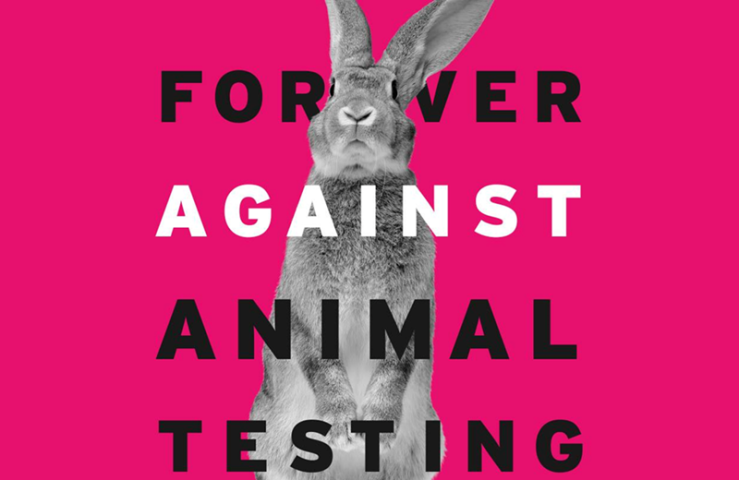
Considered one of the world’s most socially responsible brands, The Body Shop promotes causes in store and uses their packaging to raise awareness of issues. One of the brand’s biggest selling points is its commitment to “Community Trade”, ensuring safe working conditions and pay equality for workers. In 2017, The Body Shop launched their biggest ever societal marketing campaign: Forever Against Animal Testing.
The Body Shop brought an 8000-signature petition to the UN to ban animal testing worldwide. As the first global cosmetics company to fight animal testing, promoting massive campaigns like this creates a sense of loyalty among eco-conscious consumers. Consumers can feel they’re “sponsoring” the campaign by buying products, and the brand takes responsibility for a social issue in the industry. This is a very solid example of aligning social activism with a brand’s values.
Other examples: Nike’s UNITED campaign, which promotes racial equality and equal access to sports, recently announced its commitment to donate $40 million dollars to charities supporting the black community in the USA.
Anti-consumerism: Greener, simpler, and more thoughtful
Anti-consumerism is the belief that people don’t have to be “consumers”. We should prioritise buying high quality products, and only buy what we really need. Societal marketing is a way for minimalist brands to communicate how their product reduces the need for consumerism.
In 2011, outdoor wear brand Patagonia launched their “Don’t Buy This Jacket” campaign. It may seem counter-productive, as the ad features a Patagonia jacket and outlines the environmental cost of producing and shipping it to store – 135 litres of water and 20 pounds of carbon dioxide.
The ad encourages people to rethink their needs and avoid fast fashion by buying a “thoughtfully produced” and long-lasting jacket. Patagonia is essentially calling out brands which produce low quality, disposable products and contribute to waste.
This really appeals to customers who love the natural environment and value minimalism. Patagonia’s “Worn Wear” initiative extends a kind of lifetime warranty to customers, who are invited to send in products for free repairs if the brand’s online repair guides do not suffice. This is a great example of societal marketing – producing useful products with a quality and ethical advantage over competitors, which helps consumers save money and live a greener lifestyle.
As this attention-grabbing campaign actually increased sales by 30%, the campaign was a definite win for all three stakeholders in the triple bottom line.
The oldest example of this type of marketing is Volkswagen’s 1955 ad for the “The Lemon” (Bug) which urges viewers to “think small”. The ad outlines that its superior, reliable design will make the car last longer than its competitors.
How could societal marketing work for me?
Whether you’re thinking of bringing a new idea to the marketplace, societal marketing could be a worthwhile strategy for you.
Think about the problem your product solves. Does it remove the need for something else? Does it make a process more environmentally friendly by using fewer resources? Many software products reduce the need for paper as well as saving time! If this is the case, use societal marketing to focus on your product’s innovative, problem-solving side and reach out to the people who will benefit from it.
Choose causes that are relevant to your brand and that are meaningful to you and your consumer base. You don’t want to be accused of “greenwashing” or faking your commitment for PR! Look for organisations, initiatives or projects in the local community or wider world which share your values. Education initiatives or non-profits could potentially use your product.
Organise events and communicate your commitment to the cause in an appropriate way. Events such as clothes swaps, charity fundraisers, or workshops may all be worth considering.
.. And that’s a whistle stop tour of societal marketing and how it’s done!
How do you feel about societal marketing? What are the best (or worst) examples of societal marketing you have seen? How could brands do societal marketing better?